
The best family history gifts fall into several useful categories such as DNA kits and research subscriptions, archival storage supplies, personalized keepsakes, digitization tools, education and society memberships, and the gift of your own time. A custom song from Dearsong also fits into this general list, offering a keepsake the recipient can play for years.
TL;DR:
- A DNA kit is most useful for someone facing a brick wall in research, but avoid gifting one if the recipient has already tested or hasn't consented.
- Archival storage supplies like acid-free boxes and sleeves are affordable, practical, and regularly used to preserve family photos and documents.
- Personalized keepsakes such as custom history books, framed family trees, engraved items, or custom songs create lasting emotional value and are more likely to be displayed.
- For advanced genealogists, gifts like society memberships, research sessions, or custom Keepsakes better match their needs than beginner tools or generic items.
- Combining practical tools with personalized items and offering help with setup or research creates the most memorable and useful family history gifts.
Table of Contents
- Family History Gift Ideas at a Glance
- Matching Family Tree Gift Ideas to Experience Level
- When a DNA Kit or Subscription Membership Makes Sense
- Archival Storage and Preservation Supplies Worth Gifting
- Personalized Keepsakes That Actually Get Displayed
- Digitization: Scanner Gift or Scanning Service?
- Education, Memberships, and Heritage Travel as Gifts
- How to Choose: A Quick Decision Framework
- Building a Combined Gift Package
- Choosing Historical Documents and Photos to Include
- Handling Privacy and Sensitive Family History Information
- Experiential Family History Gifts Worth Considering
- What Actually Makes a Family History Gift Memorable
- A Custom Song as a Family History Keepsake
- Sources
- FAQ
Family History Gift Ideas at a Glance
Genealogy gifts work best when they solve a real problem instead of just looking the part on a shelf. Here's a fast rundown of the six categories worth your money, with rough budget tiers so you're not guessing:
- DNA kits and subscriptions: suitable for beginners or those exploring specific ancestry lines, but make sure the recipient hasn't already done testing.
- Archival supplies: acid-free and buffered storage items protect fragile photos and documents, offering great daily utility at a low cost.
- Personalized keepsakes: including custom books, framed family trees, engraved items, or commissioned songs that capture specific memories.
- Digitization tools or services: scanners or professional scanning services for managing inherited photo collections and documents.
- Education and memberships: society memberships, online courses, or conference passes provide access to special archives and knowledge.
- The gift of time: offering help with setting up kits, navigating databases, or transcribing documents, providing significant value with minimal cost.
Matching Family Tree Gift Ideas to Experience Level
Buying the wrong-level gift is the most common mistake in genealogy gifting. A seasoned researcher does not need another beginner starter kit, and a first-timer will not touch a $300 microfilm reader.
- Beginners show a handful of names on a family tree app, maybe one DNA test, and a lot of curiosity but no system yet. Good gifts: a starter DNA kit, a guided research journal, or a simple pedigree chart bundle they can fill in by hand.
- Intermediate researchers have built out several generations, hit a few brick walls, and started collecting documents in folders or boxes. Good gifts: an archival storage set, a paid subscription to a records database, or a scanning service for the photo pile they haven't organized yet.
- Advanced genealogists already own the archival basics and subscriptions, and they're often chasing specific records or writing up findings. Good gifts: a society membership, a conference pass, a custom family history book, or a personalized keepsake like a commissioned song built around a specific ancestor's story.
Before you buy, ask two questions: "What have you already tried this year?" and "What's the one thing slowing you down right now?" Those answers tell you more than any gift guide.
When a DNA Kit or Subscription Membership Makes Sense
A DNA kit is a strong gift when the recipient has hit a wall a paper trail can't solve, like an unknown grandparent or a family rumor about a different last name. It's the wrong gift when they've already tested, since duplicate kits are a surprisingly common complaint among genealogy hobbyists.
A subscription membership is often the safer bet. A short-term or annual research subscription gives someone new record sets to dig into without the one-time, unchangeable nature of a DNA result. Gift memberships and short-term access passes work well for someone who's curious but hasn't committed to a full year on their own.
- Check first: does the recipient already have DNA results sitting unused in an account?
- Consider a subscription instead if they're research-active but budget-conscious about ongoing costs.
- Pair either gift with two hours of your own time to help with setup, since pairing a tangible gift with personal help creates a far more memorable experience than the item alone.
- Respect consent: DNA results can reveal unexpected relatives or health information, so never order a kit for someone who hasn't asked for one.
Pro Tip: Include a printed note with login steps, a gift card for the site's premium record tiers, and a calendar invite for a "let's look at your results together" session. The setup help matters as much as the kit itself.
Archival Storage and Preservation Supplies Worth Gifting
Photos and documents degrade fast without the right materials, and this is where a small gift solves a real, ongoing problem. Acid-free boxes stop the slow yellowing that regular cardboard causes. Polyester sleeves (look for ones labeled archival-safe, not just "photo sleeves") protect individual documents from handling damage. Buffered tissue paper separates fragile pages so ink doesn't transfer or fold marks don't deepen over time.
Good quality, acid-free paper and stable, cool humidity genuinely extend how long materials last, sometimes by decades. When buying, match box size to the actual document dimensions (letter, legal, or oversized photo formats all need different boxes) and choose labeled, lignin-free products over generic "acid-free" claims on cheap packaging.
- Acid-free storage boxes, sized to the documents you're protecting.
- Archival polyester sleeves for loose photos and single-page documents.
- Buffered interleaving tissue for between pages in scrapbooks or albums.
- A basic hygrometer, for the researcher who wants to monitor storage humidity.
Budget-tier supplies run $15 to $40 for a starter set; museum-grade materials with UV-blocking properties climb toward $75 and up.
Personalized Keepsakes That Actually Get Displayed
The difference between an heirloom and a novelty item comes down to specificity. A generic "Family Tree" wall print says nothing. A custom book with actual names, dates, and a great-grandmother's immigration story says everything, and heirloom keepsakes and guided display items consistently top the lists of gifts people actually keep.
- Custom family history books that import tree data directly, since services that turn research into printed books save the recipient from formatting everything themselves.
- Framed family tree displays, ideally paired with a real photo, not stock clip art.
- Engraved items, like a keepsake box with a birth year or hometown.
- A custom family song built around a specific memory, nickname, or place, which works as an audio heirloom the recipient can replay at holidays for years.
| Keepsake type | Best for | Personalization detail that matters |
|---|---|---|
| Custom family history book | Advanced researchers with a built-out tree | Real dates, provenance notes, actual document scans |
| Framed family tree display | Beginners or as a shared family gift | An authentic photo, not a template graphic |
| Engraved keepsake box | Any experience level | A specific year or hometown, not a generic quote |
| Custom family song | Emotional milestones, reunions, memorials | A real story, nickname, or place woven into the lyrics |
Digitization: Scanner Gift or Scanning Service?
A flatbed photo scanner suits someone who enjoys the hands-on process and has an ongoing pile of family photos to work through. A dedicated document scanner works better for someone drowning in paper records rather than pictures, and a negative scanner is worth it only if there's an actual box of old film negatives waiting.
For a bigger backlog, a paid scanning service is often the better gift. It gets years of neglected boxes digitized without asking the recipient to spend their weekends at a scanner, and scanning accessories and services show up constantly in genealogist gift lists for exactly that reason.
- Consistent file naming (surname, year, description) so scans are searchable later.
- At least 300 DPI for documents, 600 DPI for photos meant to be enlarged.
- A backup copy on a separate drive or cloud folder, included with the gift, not left as homework.
Education, Memberships, and Heritage Travel as Gifts
A genealogy society membership opens up regional record collections and local expertise that no subscription database fully replicates, and it usually costs less than one DNA kit for a full year of access. Short-term course packages work well for someone who wants to level up a specific skill, like reading old handwriting or researching immigration records.
Free resources are worth mentioning too. Family history guidance from LDS-affiliated resources gives beginners a no-cost way to start before committing to paid tools.
- A conference pass suits an intermediate or advanced researcher who wants specialized workshops, not general overviews.
- A heritage trip or archival research session is a reasonable splurge for someone chasing a specific ancestral town or record office, but confirm travel dates and archive hours before booking anything.
- Match the format to personality: some researchers want a weekend workshop, others want a slow, self-paced online course.
How to Choose: A Quick Decision Framework
Before you check out, run through a short mental checklist. Does the gift match their actual stage, or is it aimed at beginners when they're already advanced? Will it still be useful in five years, or is it a one-season novelty? If it involves DNA or personal records, have you confirmed they actually want that information surfaced?
- Ask directly: "Do you already have a DNA kit or an active subscription?"
- Ask subtly: "What's been the most frustrating part of your research lately?"
- Red flag: novelty items with genealogy-themed graphics but no real research function.
- Red flag: cheap "archival" supplies without a lignin-free or acid-free certification listed.
- Red flag: subscriptions that can't transfer to the recipient's existing account.
Budget tiers roughly break down as: under $30 for supplies or a small charts bundle, $50 to $100 for a personalized keepsake or a custom song, and $150 and up for memberships, conferences, or DNA and subscription bundles.
Pro Tip: If you're unsure of their stage, ask a family member who talks to them regularly instead of guessing. A five-minute text saves you from buying a duplicate kit.
Building a Combined Gift Package
The most memorable family history gifts rarely come from a single item. Combining categories lets you cover both the practical and emotional sides of the hobby in one package, and it usually costs less than buying two full-price standalone gifts.
A strong combination pairs a practical tool with a personal keepsake. Give an archival storage box alongside a handful of restored photo prints, or a subscription gift card next to a printed guide showing how to use it. For someone who already has the practical basics covered, pair a custom family song with a framed photo from the story the song is based on, so the visual and the audio reinforce each other.
Layering in your own time changes the entire feel of the gift. Offering to sit down together and go through a new subscription, or transcribing a relative's letters as a surprise addition, turns a purchase into an experience. Gifts that solve an actual research problem tend to land better than decorative items regardless of price, and a combined package almost always solves more than one problem at once.
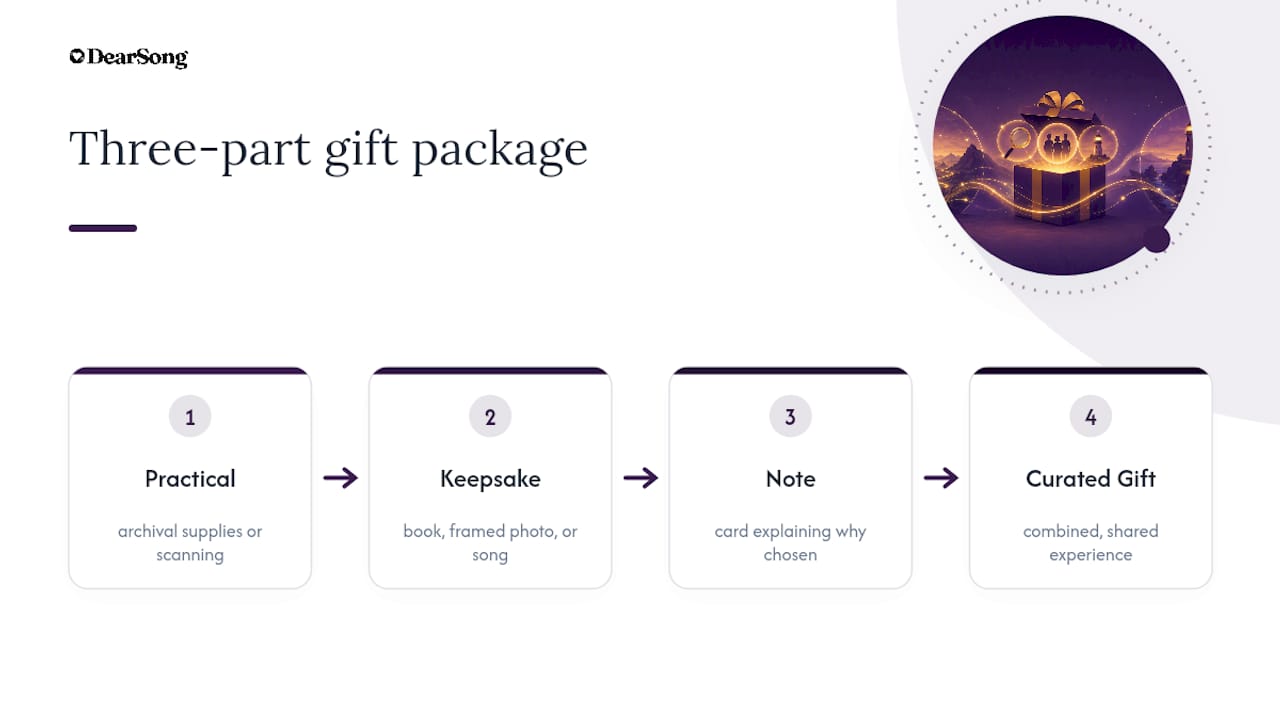
A simple three-part package works for most budgets: one practical item (archival supplies or a scanning service), one personalized keepsake (a book, framed display, or song), and one card or note explaining the story behind your choices. That last part matters more than people expect. Explaining why you picked what you picked turns a generic bundle into something that feels curated specifically for them.
Choosing Historical Documents and Photos to Include
Not every old photo or document makes a good gift addition, and picking poorly can turn a thoughtful gesture into clutter. Start with items tied to a specific, tellable story rather than generic family snapshots. A wedding photo with a known date and location beats a stack of unlabeled 1970s vacation pictures every time.
Look for documents with built-in narrative value: immigration papers, military records, letters, or a christening certificate. These carry names, dates, and places that make them useful for research, not just sentimental. If you're including physical originals, always make a scanned backup first, since gifting the only copy of a fragile document risks losing it entirely.
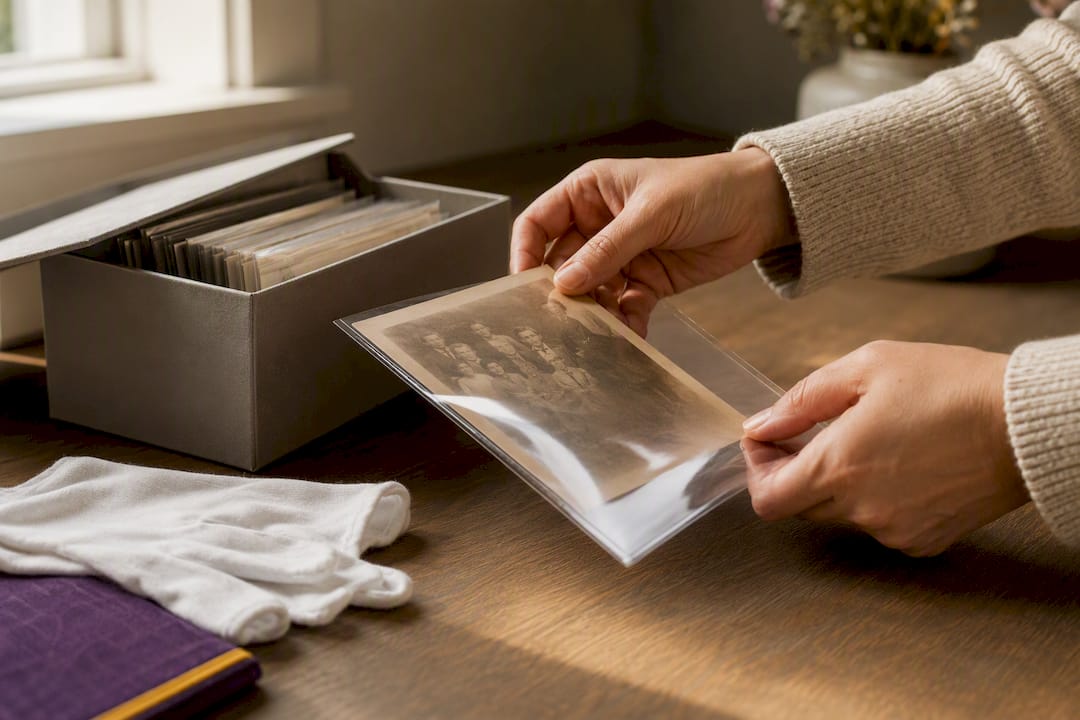
When you do include a scan or original, add basic context alongside it, like a short provenance note explaining where the item came from and how it connects to the family line. A sentence like "Found in Grandma Ruth's cedar chest, believed to be from her wedding in 1952" turns a mystery photo into a usable research clue.
If you're pairing a document with a custom keepsake like a family history book or a commissioned song, pull the specific detail from the document itself, a full name, a town, a date, rather than a vague family reference. That specificity is what separates a meaningful gift from a generic one.
Handling Privacy and Sensitive Family History Information
Family history gifts can surface information the recipient never asked to know, and that's worth pausing on before you buy anything DNA-related or dig deep in an archive. Unexpected biological relatives, adoption details, or health predispositions can all show up in a DNA result, and delivering that as a surprise gift removes the recipient's ability to consent to knowing it.
The safer approach is to ask directly before buying a DNA kit, rather than assuming a surprise will be welcome. If you're gifting access to a subscription or shared family tree, check with other living relatives before including sensitive details like divorce records, adoption information, or facts about people still alive.
Photos and documents carry their own sensitivity too. A photo of a difficult period, an estranged relative, or a family conflict might be historically accurate but emotionally loaded to include in a cheerful gift package. When in doubt, ask the recipient what they'd like included rather than deciding for them.
This is also where personalized keepsakes like a custom song benefit from a light touch. Framing a memory with warmth and specificity works well, but it's worth checking that the story you're building the gift around is one the recipient is comfortable having documented and shared, especially if the song might get played at a family gathering.
Experiential Family History Gifts Worth Considering
Not every meaningful gift is an object. A guided research session at a local archive or historical society gives a genealogist hands-on time with records that never made it online, and many local archives offer these sessions for a modest fee or even free with an appointment.
A heritage trip, visiting an ancestral hometown, a cemetery where relatives are buried, or a regional archive tied to the family's origin, works as a genuine splurge gift for someone with a specific research target in mind. Confirm archive hours and appointment requirements before booking travel, since many smaller record offices operate limited hours.
For a lower-cost experience, consider gifting a paid research session with a professional genealogist who specializes in a specific region or record type. This solves brick walls faster than months of solo digging, and it's a gift that respects the recipient's existing skill level instead of assuming they need to start over.
Local genealogical societies sometimes run guided cemetery walks, courthouse record days, or beginner workshops that make for an easy, low-cost experience gift. Pairing an experience like this with a tangible keepsake, a printed summary of what was found, or a custom song written about the ancestor being researched, gives the day a lasting artifact instead of just a memory that fades.
What Actually Makes a Family History Gift Memorable
The best family history gift I've seen work wasn't the most expensive one. It was a grandson who transcribed his grandmother's handwritten recipe cards into a printed book, then had a song written around her favorite phrase for the reveal. The book got used. The song got replayed at every holiday after that.
That's the pattern worth remembering: physical items get appreciated, but pairing them with your own time, or with something built entirely around one specific story, is what turns a gift into a family artifact....
— Vlad
A Custom Song as a Family History Keepsake
Most family history gifts are objects the recipient has to do something with, organize, scan, or read. Dearsong works differently. You give the story once, and what comes back is a finished song built around it, ready to play at a reunion or send privately the same day it's finished.
The process starts with a short brief: the recipient's name, the occasion, key memories, nicknames, places, and the mood or musical style you have in mind. The Essential package runs $59 for one original song up to three minutes, delivered as an MP3 with a private YouTube link within 24 hours of submitting your form. The Signature package runs $89 and adds priority delivery within 12 hours, two song versions to pick between, one free lyric rewrite, and a printable gift poster with a QR code linking straight to the song.
For a family history gift, pair the song with something visual, a framed photo tied to the story in the lyrics, or a printed custom family history book, so the recipient has both something to hear and something to hold. A song works especially well for milestone birthdays, anniversaries, or memorial tributes honoring someone the family has lost. Check the how it works page for exactly what details to include in your brief before you start.
Sources
- Embrace your family heritage: 13 great gifts to learn more about family history — Ancestry Blog
- 12 Family Tree Gift Ideas for Genealogy Lovers & Family Historians — FamilySearch blog
- 30 Of The Best Genealogy Gift Ideas For Family Historians — Heritage Discovered
- Ancestry Family History Book | MyCanvas
FAQ
What's the best gift for someone just starting genealogy research?
A starter DNA kit, a guided research journal, or a basic pedigree chart bundle all work well for beginners since they build a foundation without overwhelming someone new. Confirm first that they haven't already tested with a DNA kit through a relative's gift.
Are archival storage supplies really worth gifting?
Yes. Acid-free boxes, archival sleeves, and buffered tissue directly protect against the yellowing and deterioration that damage family photos and documents over time, and stable storage conditions can extend material life by decades. They're inexpensive and get used constantly.
How much does a custom family history song cost?
Dearsong's Essential package costs $59 for one song delivered within 24 hours, and the Signature package costs $89 and adds a second song version, a lyric rewrite, and a printable poster within 12 hours.
Should I gift a DNA kit if I'm not sure they want one?
Ask first. DNA results can reveal unexpected relatives or sensitive health information, and surprising someone with a DNA test removes their ability to consent to what they might learn.
What's a good gift for an advanced genealogist who already has everything?
Look toward experiences and personalization rather than tools: a society membership, a research session with a professional genealogist, a custom family history book, or a commissioned song built around a specific ancestor's story tend to land better than another database subscription.