
A family reunion song is a custom-written track built from your family's actual names, inside jokes, and stories, recorded and delivered as an MP3 or private streaming link, often within 24 hours. Instead of a card everyone signs and forgets, you get a piece of music the whole family can play at the event and keep for years. Services like Dearsong can turn a short written brief into a finished song fast enough to use for a reunion happening this weekend.
TL;DR:
- A family reunion song should focus on specific, vivid memories and relationships to create an emotional connection in under three minutes.
- Timing the song during key moments like a slideshow or just before a toast enhances its emotional impact and memorability.
- Providing detailed, personal anecdotes, names, and family-specific references in the brief results in a more authentic and meaningful song from the first draft.
- Reputable services like Dearsong deliver finished songs within hours for prices from $35 to $89, with options for revisions and additional versions.
- Using original composition avoids legal issues related to copyrighted melodies, ensuring the song remains a private, personal family keepsake.
Table of Contents
- What Makes a Family Reunion Song Worth the Effort?
- What Should You Put in the Songwriting Brief?
- When Should You Play the Song at the Reunion?
- What Songwriting Choices Make a Family Song Feel Real?
- What Turnaround, Files, and Pricing Should You Expect?
- How Do You Write Lyrics Everyone in the Family Actually Likes?
- Which Musical Genre Fits Your Family's Background?
- How Can the Whole Family Help Shape the Song?
- Do You Need Permission to Use an Existing Melody or Sample?
- Why a Simple Brief Beats a Perfect One
- How to Order a Family Reunion Song With Dearsong
- Helpful Resources on Custom Songs and Event Planning
- Sources
- FAQ
What Makes a Family Reunion Song Worth the Effort?
A good reunion song does something a slideshow or a toast can't: it compresses forty years of scattered memories into three minutes that everyone can feel at once. Grandpa's fishing stories, the cousin who always burns the hot dogs, the family lake house that's been sold but never forgotten. A songwriter working from real details can stitch those threads into one narrative that lands emotionally instead of just informationally.
That emotional payoff is why personal songs are increasingly showing up at modern celebrations as a substitute for the usual toast or speech. A song gives an event a fixed emotional moment without asking three different relatives to find the right words on the spot.
Beyond the event itself, a custom song has a second life:
- It plays during the reunion as a defined program moment, not background noise.
- It gets shared afterward in the family group chat, at the next holiday, or at a future reunion.
- It becomes an archived keepsake that outlasts the photo album, especially useful for relatives who couldn't attend in person.
- It replaces the pressure of a live speech with something rehearsed, polished, and repeatable.
What Should You Put in the Songwriting Brief?
The brief is the single most important part of the process. A songwriter can only write what you give them, and vague input produces a vague song. Custom-song services consistently advise giving key names, dates, inside jokes, and genre preferences upfront rather than leaving the writer to guess.
Work through this checklist before you sit down to fill out any form:
- Occasion and framing. Name the reunion specifically. Is it an annual gathering, a milestone (50 years since the family bought the farm), or a one-time event honoring someone?
- Who it's for. List the recipients or the group being celebrated. A song for "the whole Martinez clan" needs different pacing than one aimed at three siblings.
- Three to six real memories. Pick specific, vivid anecdotes rather than general traits. "Uncle Ray's terrible karaoke at every Fourth of July" beats "Uncle Ray is fun."
- Names and relationships. List nicknames, maiden names, and who's related to whom. Songwriters get this wrong constantly when it's left out.
- Musical direction. Pick a genre, tempo, and vocal style (male, female, group harmony), plus one or two reference songs that capture the mood you want.
- Tone and boundaries. Note what should stay in (a specific inside joke) and what should stay out (a sensitive family topic that doesn't belong in a celebration song).
Providing sensory detail and specific anecdotes tends to cut down on revision rounds and produces lyrics that feel emotionally accurate on the first pass, rather than generic filler that needs three rewrites to fix.
Pro Tip: Write your memories the way you'd tell them at the dinner table, not the way you'd write them in a formal bio. "Grandma always kept a jar of peppermints by the door" is more useful to a songwriter than "Grandma was welcoming and generous."
When Should You Play the Song at the Reunion?
Timing decides whether a song becomes the highlight of the day or gets lost under chatter. The strongest moments are usually a photo slideshow, right before or after a toast, or as a closing number as people start saying goodbyes. A quieter moment, like right after a meal, also works well because attention is naturally settled.
Custom songs are commonly used for exactly this kind of defined program moment, the same way a first dance or a surprise reveal anchors a wedding reception. A single song replacing multiple speeches also keeps the emotional peak from getting diluted across several people talking one after another.
A short technical checklist before showtime:
- Confirm the file format (MP3 works everywhere) and download it in advance rather than relying on venue Wi Fi.
- Decide between a private streaming link and a downloaded file, and have both ready as backup.
- Test the speaker setup and volume level before guests arrive, not while they're watching.
- Give the DJ or MC the exact cue point and a short introduction line, or arrange for a family member to introduce it live.
What Songwriting Choices Make a Family Song Feel Real?
The structure matters more than most people expect. Verses should carry the specific, time bound stories, the things that actually happened on a particular day, while the chorus states the broader theme the whole family shares, whether that's belonging, gratitude, or simply "home." That split lets a song stay personal in the details while still feeling inclusive to relatives who weren't part of every individual story.
A few practical rules keep the result from feeling like a template with names dropped in:
- Name only the people central to the moment; listing twenty cousins in one verse turns a song into a roll call.
- Aim for roughly two to three minutes. That's long enough to tell a real story and short enough to hold attention during a slideshow or toast.
- Choose a genre and vocal style that fits the room's age range. A country ballad or a warm acoustic pop sound tends to read as accessible across generations; a heavy niche genre style can alienate half the room.
- Skip references that only three people will understand unless you're deliberately writing for an inside-joke moment rather than the whole family.
Pro Tip: If your family spans four generations, write the chorus around a theme everyone shares, like a specific house, a shared last name, or a tradition, and save the ultra-specific jokes for a single verse instead of spreading them throughout.
What Turnaround, Files, and Pricing Should You Expect?
Reputable custom-song providers work fast because reunions often get planned or finalized on short notice. Dearsong delivers a finished Essential package at $35 with one original song, up to three minutes, delivered as an MP3 with a private link. The Signature package at $89 adds two song versions to choose between, one free lyric rewrite, priority delivery, and a printable gift poster with a QR code linking to the track.
What you should expect from a standard order:
- An MP3 download you can keep, forward, or burn to a drive.
- A private streaming link you can text or email without uploading anything public.
- A delivery window measured in hours, not days, once your brief is submitted.
- The option to request a rewrite if the first version needs a tone adjustment.
Fast, AI-assisted production workflows have made this kind of same-day turnaround realistic even for last-minute reunion planning, where the group chat decides on Tuesday and the reunion is Saturday.
How Do You Write Lyrics Everyone in the Family Actually Likes?
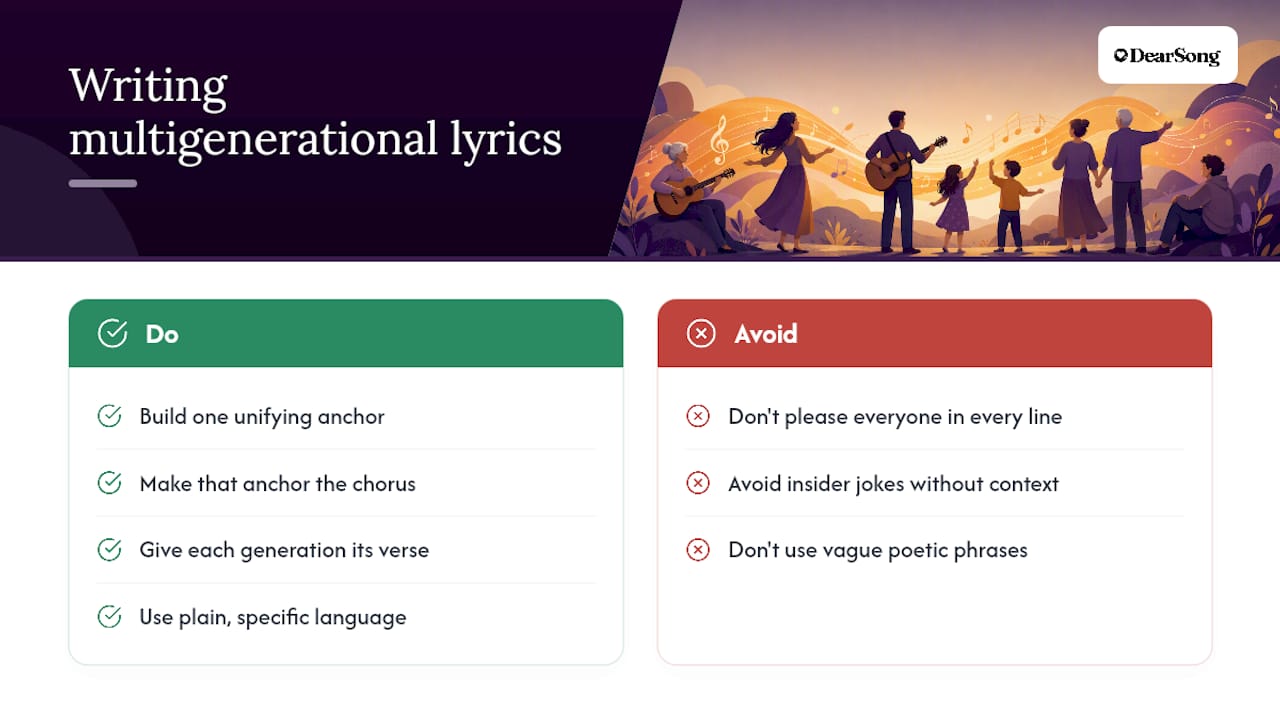
The hardest part of a multigenerational song is writing something a nine-year-old cousin and an eighty-year-old grandmother both recognize as "us." The fix isn't to please everyone equally in every line. It's to build one unifying idea, then let individual verses rotate through different people's memories so nobody feels erased and nobody feels like the whole song is about them.
Start with a shared anchor: the house, the lake, the recipe that gets made every year, the road trip that became legend. That anchor becomes your chorus. From there, verses can each spotlight a different branch of the family without breaking the song's spine. One verse for the grandparents' generation, one for the middle generation, maybe a closing verse that nods to the kids growing up in this tradition now.
Avoid inside jokes that only a small cluster understands unless you're using them briefly and clearly, with enough context in the line itself that an outsider can still follow along. "Dad's famous 'five more minutes' before every road trip" works because the joke explains itself. A jargon-heavy reference to a moment nobody outside three people witnessed usually falls flat.
Keep the language plain and specific rather than poetic and vague. Concrete nouns, real place names, and actual nicknames do more emotional work than abstract phrases like "precious memories" or "moments we cherish." Specificity is what makes a listener go quiet, not generality.
Which Musical Genre Fits Your Family's Background?
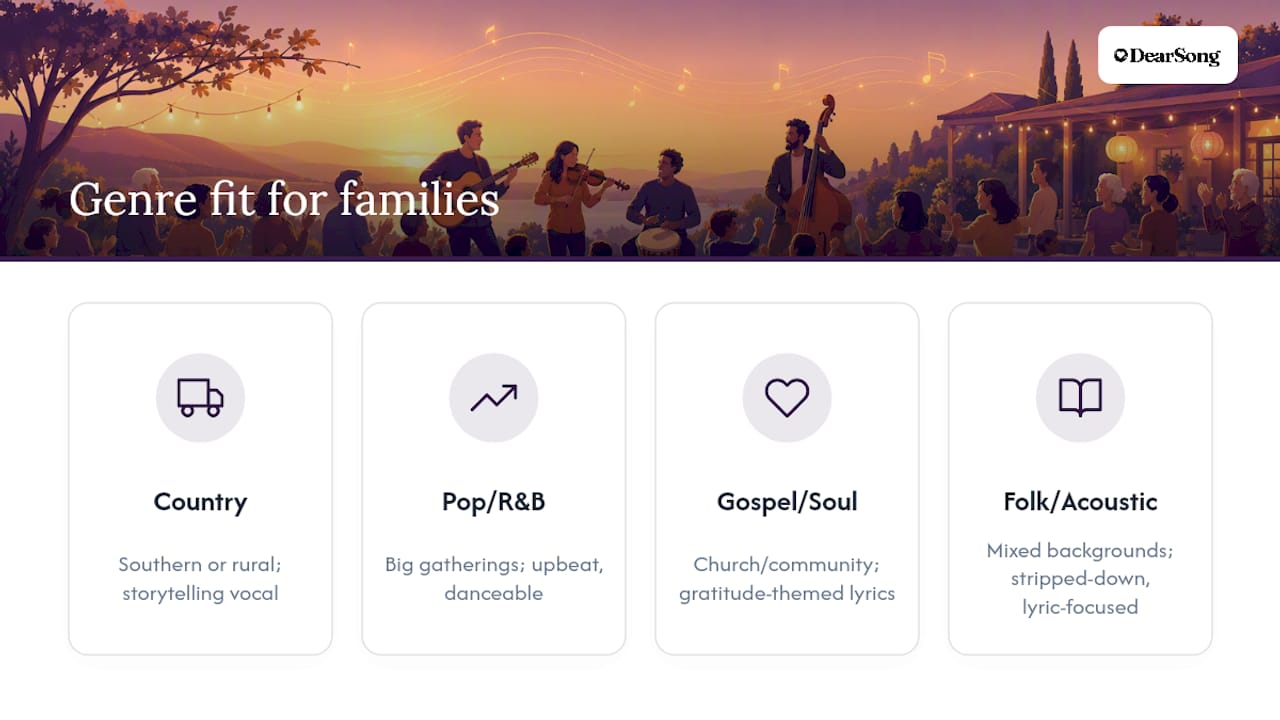
There's no single right genre for a reunion song, but the choice should reflect who's actually in the room. A family with deep Southern or rural roots often responds well to country or Americana, with acoustic guitar and a storytelling vocal delivery that mirrors how the family already tells stories out loud.
Families that lean toward big group gatherings, dancing, and celebration might do better with an upbeat pop or R&B arrangement, something that can play during a slideshow but could also carry a dance floor moment later in the night. Gospel or soul arrangements work particularly well for families with strong church or community traditions, especially when the lyrics lean into themes of gratitude and legacy.
For families with mixed cultural backgrounds, a stripped-down acoustic folk or singer-songwriter style tends to travel best across generations and traditions because it doesn't lean hard on any one cultural sound. It leaves room for the words to carry the specificity instead.
Whatever genre you pick, match the vocal style to the mood you actually want in the room. A warm solo vocal suits a reflective, sentimental piece. A fuller arrangement with harmonies suits a louder, more celebratory reunion where people expect to sing along by the second chorus.
How Can the Whole Family Help Shape the Song?
A reunion song gets stronger when more than one person contributes material, even if only one person ends up filling out the actual brief. Send a short group text or a shared document asking relatives for one memory each, a favorite family phrase, or a moment they still bring up. You'll get more raw material in a day than you would writing alone for a week.
Assign specific people to specific questions instead of one open-ended ask. One cousin might remember exact dates and locations. An aunt might remember phrases and nicknames nobody else recalls. A grandparent might have the one detail that makes the whole song click, a first house, a wedding date, a name nobody else in the family even knew.
If the song is meant to be a surprise for a specific person or generation, keep the collection process discreet and route the answers to one organizer who compiles them into the final brief. If it's meant to be a collaborative family project instead, treat the writing process itself as part of the reunion. Read submitted memories out loud before the event, or debut the finished song as a group moment rather than a private reveal.
Do You Need Permission to Use an Existing Melody or Sample?
Using someone else's copyrighted melody, sample, or recognizable lyrics in a song you plan to play at a reunion or share publicly generally requires a license from the rights holder, and that licensing process is neither quick nor cheap for a one-time family event. Copyright law protects both the composition and, separately, a specific recording, so even a short sampled clip can carry legal exposure if it's shared beyond a private living room.
The simpler and safer path for a reunion song is an entirely original composition written specifically for your family, which avoids licensing questions altogether. A reference song is useful during the briefing stage purely as a mood guide for tempo, instrumentation, or vocal style. It should never be treated as material to copy directly into the finished track.
If you want a melody that echoes a beloved song's feeling, tell the songwriter that directly as a style reference rather than asking them to recreate specific melodic lines or lyrics. A skilled writer can capture a similar warmth or energy without borrowing anything that creates legal risk for you or the provider.
Why a Simple Brief Beats a Perfect One
The families that end up with the best reunion songs aren't the ones who write the most polished briefs. They're the ones who write the most honest ones. A messy paragraph about "the year Dad tried to smoke a whole pig and set off the neighbor's fire alarm" gives a songwriter more to work with than three tidy, careful sentences about "family togetherness."
What surprises people most is how little polish actually matters. Nobody is grading your spelling or your sentence structure on that brief form. What matters is specificity, and specificity almost always sounds a little rough around the edges before it becomes a lyric. Dearsong's ordering process is built around collecting exactly this kind of raw material, names, memories, mood, and genre, straight from the person who knows the family best, which is usually not a professional writer.
The other thing conventional advice gets wrong is treating length as a virtue. A reunion song does not need to cover every relative or every decade. The songs that actually make a room go quiet are the ones that pick two or three true things and tell them well, rather than the ones trying to fit the whole family tree into three minutes.
— Vlad
How to Order a Family Reunion Song With Dearsong
Dearsong is the direct route to a finished family reunion song without hiring a composer or waiting weeks for a demo. Ordering takes three steps: pick a package, fill out a short song-details form, and receive your finished track.

Start by choosing between the Essential package at $35, which includes one original song up to three minutes with an MP3 and private link, or the Signature package at $89, which adds a second song version, one free lyric rewrite, priority delivery, and a printable gift poster with a QR code. Payment happens first, then you'll complete the song-details form with names, memories, mood, genre, and up to two reference songs. That's the moment worth preparing for ahead of time. Pull together your family's specific anecdotes and nicknames before you sit down to fill it out, so the brief comes together in minutes instead of an afternoon. If your reunion centers on a particular relationship rather than the whole family, the custom family song page walks through the same process for that more focused option. Once your form is submitted, the delivery clock starts, and your song lands as an MP3 and private streaming link ready to play at the reunion.
Helpful Resources on Custom Songs and Event Planning
A few outside resources worth a look if you're weighing whether a personal song fits your event: The Salford Magazine covers why personal songs are becoming a fixture at modern celebrations, Custom Song breaks down what songwriters actually need in a brief, and Noise offers practical family event-planning advice for scheduling a program moment like this.
Sources
- Why Personal Songs Are Becoming Part of Modern Celebrations - The Salford Magazine
- 5 Must-Have Details for Your Perfect Custom Song (2026) - Custom Song
- The Invisible Boost: Why Events With Custom AI Songs Feel Better - Sean Jacquin (Medium)
- How a Custom Song Becomes a Family Keepsake - PunsWave
FAQ
How Much Does a Family Reunion Song Cost?
Dearsong's Essential package is $35 for one original song up to three minutes with an MP3 and private link. The Signature package is $89 and adds a second song version, a free lyric rewrite, priority delivery, and a printable QR poster.
How Long Does It Take to Get a Custom Reunion Song?
Delivery windows are typically measured in hours rather than days once your song-details form is submitted. Priority tiers can shorten that window further, which matters if your reunion is only days away.
What Information Do I Need to Provide?
You'll need the occasion, recipient names and relationships, three to six specific memories, and your musical preferences like genre, tempo, and vocal style. Custom-song services consistently find that providing names, dates, and inside jokes upfront produces a far more personal result than a vague request.
Can I Use an Existing Popular Song Instead of Writing an Original?
Using a copyrighted melody or recording without a license carries real legal risk, even for a private family event. An original composition written from your family's own details avoids that problem entirely and usually sounds more personal than a cover ever could.
Where Should the Song Play During the Reunion?
The strongest spots are during a photo slideshow, right before or after a toast, or as a closing moment as the event wraps up. A single song moment tends to land better than spreading the same emotional weight across several separate speeches.