
If you want a meaningful family keepsake, commission a short, story-driven original song built around the moments only your family would recognize. A "family song" here means a custom original track written from your own memories, not a recording pulled from a streaming playlist. The single best first move: pick the occasion, name the emotional goal, and hand the songwriter two or three specific, vivid memories.
TL;DR:
- Personal details, specific memories, and familiar genres in your brief significantly improve the song's emotional authenticity and relevance.
- Fast turnaround options are available, with some packages delivering within 12 to 24 hours after submitting detailed instructions.
- For intimate or nostalgic songs, request low-energy, acoustic arrangements; for celebration anthems, opt for upbeat, energetic styles.
- Providing clear, concrete scenes and sensory details helps the songwriter craft a meaningful and personalized musical tribute.
- Confirm revision policies, format options, and ownership rights upfront to ensure the final song meets your family's needs before commissioning.
Table of Contents
- 10 Family Song Ideas by Occasion (With Ready-to-Copy Prompts)
- What to Put in Your Brief: A Checklist and Sample Lines
- How to Pick a Style That Actually Feels Personal
- What Timelines and Pricing Usually Look Like
- Presenting the Song: From Surprise Reveal to Lasting Keepsake
- Getting Multiple Family Members Involved Without Losing the Plot
- Weaving Family Traditions and Culture Into the Song
- Sample Creative Briefs You Can Copy Directly
- Choosing the Right Songwriter or Service
- Common Pitfalls When Commissioning a Family Song
- Preserving and Sharing the Song for Years to Come
- Why a Custom Family Song Sticks Around Longer Than Most Gifts
- Start Your Family Song With a Simple Brief
- Sources
- FAQ
10 Family Song Ideas by Occasion (With Ready-to-Copy Prompts)
Every family occasion calls for a different emotional register. Below are ten commissioning ideas, each with a starting brief you can copy, tweak, and send.
-
Wedding first dance. Emotional goal: warmth and continuity. Motif to include: how the couple met or a private nickname. Suggested mood: mid-tempo acoustic pop, 3 minutes. Try: "Write a song about the moment we knew, starting with the rainy parking lot where we first talked." A custom wedding song built this way plays very differently than a generic first-dance pick.
-
Milestone birthday. Build the chorus around a life-story arc, from childhood scenes to who they are now. Tone: celebratory but sincere, not comedic unless the family leans that way. A custom birthday song works especially well for round-number birthdays (40th, 60th, 80th).
-
Memorial or celebration of life. Keep the motif gentle. Name specific memories: a Sunday ritual, a favorite phrase, a place they loved. Avoid generic "gone but not forgotten" language in the brief; specificity is what makes it land.
-
Family reunion anthem. Give the songwriter a chantable chorus hook, maybe a family name or shared saying, so everyone can sing along by the second listen.
-
Newborn lullaby. Short form, 90 seconds to two minutes. Lyrical starters: the baby's name, the due date or birth story, one hope for their future.
-
Anniversary timeline song. Structure verses by decade: how they met, early struggles, raising kids, where they are now. A custom anniversary song built this way becomes a mini audio memoir.
-
Sibling roast or inside-joke tune. Humorous angle, but list explicit no-go topics up front (exes, health issues, old fights) so the joke stays affectionate.
-
Grandparent tribute. Lean on sensory detail: the smell of their kitchen, a specific chair, a phrase they repeated. Suggest warm instrumentation like piano or acoustic guitar.
-
Pet memorial or celebration. Playful motifs work here, plus the pet's actual nicknames and quirks.
-
Slideshow soundtrack. Give pacing notes and rough cue points so musical shifts match key photos.
What to Put in Your Brief: A Checklist and Sample Lines
A songwriter can only write what you give them. The strongest briefs cover:
- Occasion and relationship to the recipient
- Two to three specific memories, not general themes
- Nicknames, inside phrases, or recurring family sayings
- The core emotion you want (comfort, joy, nostalgia, humor)
- One or two reference tracks for genre and feel
- Preferred tempo and target length
- Explicit no-go topics or words
- Deliverable format (MP3, WAV, video-ready file)
Weak brief: "Write something sweet about my mom." Strong brief: "Write about my mom teaching me to drive her old blue Honda, the way she'd hum along to the radio, and how she still calls me 'kiddo' at 34." The second version gives an actual scene, a sound detail, and a phrase the songwriter can build a hook around. That specificity is exactly what research on commissioned music workflows points to: gathering the story before picking mood and structure produces a far more personal result than starting from a vague theme.
Before you commission anyone, confirm three contractual basics: how many revisions are included, what file formats you'll receive, and whether the song is work-for-hire (you own it outright) or licensed for personal use only.
Pro Tip: Write your brief as if you're texting a friend the story, not as if you're filling out a form. The messier, more specific version is usually the better brief.
How to Pick a Style That Actually Feels Personal
Familiarity and genre matter more than any other musical variable when it comes to whether a song feels like "yours." Research on constructed music-evoked memories found that familiarity and genre are the strongest predictors of perceived fit between a listener and a song, outweighing technical details like tempo or key. That's why supplying one or two reference tracks does more work than describing abstract moods.
Energy level matters too. A study of 233 adults analyzing musical features and memory found that quieter, more acoustic songs tend to cue vivid, unique, and deeply personal memories, while higher-energy, danceable songs cue more social, excited memories. If the goal is an intimate memorial or a lullaby, ask for acoustic and low-energy. If the goal is a reunion anthem people will sing at the party, ask for something upbeat and rhythmic.
Simple rules to bring into your brief:
- Want deep intimacy or nostalgia? Request acoustic, low-energy, stripped-down arrangements.
- Want celebration or group singing? Request an upbeat, danceable, higher-energy feel.
- Want it to feel instantly familiar? Name a genre and attach one or two reference songs rather than describing the sound in adjectives.
What Timelines and Pricing Usually Look Like
Short keepsakes, like a lullaby or a birthday tribute, typically move faster than full wedding productions or multi-verse tribute songs, since scope directly affects both cost and delivery time. A three-minute personal song is a much smaller lift than a live-band wedding arrangement.
For a concrete reference point, one package offers an original song up to three minutes, delivered within 24 hours of your completed form. An upgraded package adds priority 12-hour delivery, two song versions to pick between, one free lyric rewrite, and a printable gift poster with a QR code linking to the song.
Planning around an event date:
- Submit your brief at least a day or two before you need the final file, even with fast delivery, in case you want the lyric rewrite option.
- The delivery clock starts only after you submit the completed song-details form, not at checkout.
- Build in time to test playback on the actual speaker or device you'll use at the event.
Presenting the Song: From Surprise Reveal to Lasting Keepsake
How you present a commissioned song can matter as much as the writing itself.
- Surprise playback. Queue it quietly during a toast or gift-opening moment.
- Slideshow integration. Sync it under a photo montage at a reception or memorial gathering.
- QR-code poster. A printed poster with a scannable code lets guests hear the song anytime.
- Private link for distant family. A private YouTube link lets relatives who couldn't travel listen on their own time.
- Printed program insert. Add a line and QR code to a wedding or memorial program.
- USB or physical keepsake. Some families burn the file to a small drive as a durable backup gift.
For technical setup, request both an MP3 for easy sharing and a WAV if you'll run it through a venue's sound system. Test the audio on the actual speaker beforehand; small PA systems can distort quiet acoustic songs at high volume.
Pro Tip: For memorial songs, decide in advance whether the file stays private among family or gets shared publicly. Ask living relatives who are featured in the lyrics before posting anywhere public.
Getting Multiple Family Members Involved Without Losing the Plot
Too many voices in a songwriting brief can flatten the story into something generic. The fix isn't excluding people. It's assigning each person a narrow lane.
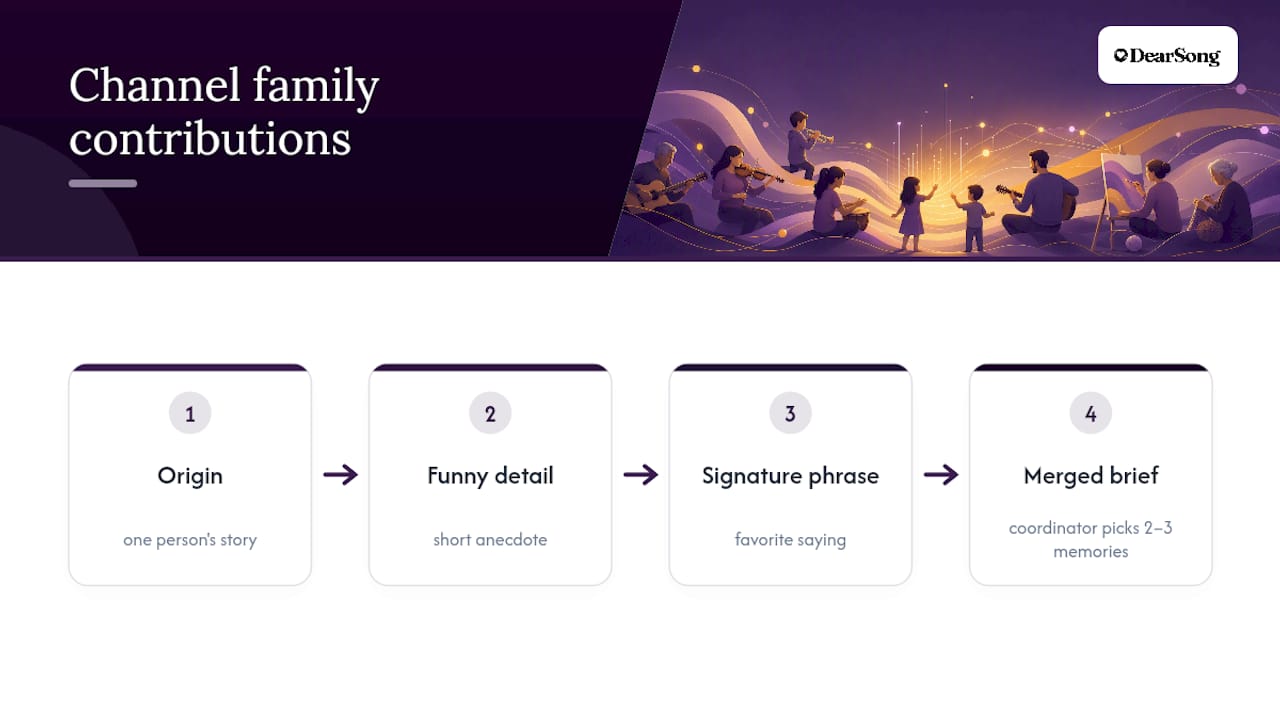
Ask one relative for the origin story, another for a funny detail, another for a phrase the person always said. Collect these separately, then have one person (often whoever is placing the order) merge them into a single brief with two or three standout memories, not a dozen competing ones. A group text or shared document works fine for gathering raw material. Just don't send the songwriter a twenty-item list of loosely connected anecdotes. The strongest commissioned songs tend to center on a handful of scenes, not an inventory.
If siblings or cousins disagree on tone, let the guest of honor's personality settle it. A song for a reserved grandfather probably shouldn't be as playful as one for a sibling who loves being teased. When family members genuinely can't agree, consider requesting two shorter verses instead of forcing one shared draft, each anchored to a different contributor's memory, stitched together by a common chorus.
Weaving Family Traditions and Culture Into the Song
A family song gets more distinctive, not less, when it reflects specific cultural or religious touchpoints rather than generic sentiment. If Sunday dinners always included a specific dish, name it. If a grandparent sang in another language, ask for a line or phrase in that language, even a single word repeated as a hook. If a family observes a particular holiday ritual, a lighting ceremony, a specific blessing, a seasonal gathering, that detail belongs in the brief.
Instrumentation can carry culture too. A family with roots in Ireland might ask for a fiddle or tin whistle line. A family with a strong gospel tradition might request a choir-style backing vocal. None of this requires fluency in music theory from you; naming the tradition and letting the songwriter translate it into sound is the point of commissioning rather than writing it yourself.
Mixed-heritage families sometimes worry about which tradition "wins." The honest answer: name both, and let one or two details from each side surface in different parts of the song, a lyric nod to one grandmother's kitchen and an instrumental touch tied to the other side's music. That balance usually reads as more authentic than picking one tradition and ignoring the other.
Sample Creative Briefs You Can Copy Directly
A brief doesn't need to be long. It needs to be specific. Here's a compact template:
Occasion: [wedding / birthday / memorial / reunion / other] Recipient and relationship: [name, how they're connected to you] Core memories (2–3): [specific scenes, not themes] Nicknames or phrases: [words only your family uses] Emotional goal: [comfort, joy, nostalgia, humor, pride] Reference tracks: [1–2 songs for genre and feel] Tempo and length: [slow ballad, upbeat 3 minutes, etc.] No-go topics: [anything off limits]
Filled-in example for a grandmother's 80th birthday: "Occasion: 80th birthday. Recipient: my grandmother, Rosa. Memories: her Saturday morning pancake ritual, the garden she's kept for 40 years, the way she calls everyone 'mija' regardless of gender. Emotional goal: warm, celebratory, a little playful. Reference: something in the style of a gentle folk ballad. Length: 3 minutes. No-go: don't mention her recent hip surgery."
That level of detail takes five minutes to write and gives the songwriter everything needed to avoid generic filler lyrics.
Choosing the Right Songwriter or Service
Not every commissioned-song provider fits every family's needs, so match the service to what actually matters to you: turnaround speed, revision policy, and how much personal detail the intake process actually captures.
Look for a service with a structured intake form rather than a vague "tell us about them" box. The more specific fields it asks for, names, places, sensory details, the better the finished song tends to reflect the real relationship rather than sounding like a template with a name swapped in. Confirm delivery windows before you order, especially against event deadlines, and check whether revisions are included or billed separately. A money-back guarantee is worth asking about directly if the service doesn't list one clearly.
Price transparency matters too. A provider that lists exact package pricing upfront, rather than "request a quote," makes it easier to plan around a birthday or wedding date without last-minute surprises.
Common Pitfalls When Commissioning a Family Song
The most common mistake is submitting a brief that's emotionally accurate but factually thin. "Make it heartfelt" tells a songwriter nothing actionable. Fix it by naming actual scenes, not adjectives.
The second pitfall is skipping reference tracks. Without at least one, the songwriter is guessing at genre, and genre is one of the two biggest factors in whether a song feels like it fits, according to the CoMEEM research on personalized song recommendations. Attach even an imperfect reference song rather than none.
Third: waiting too long before a deadline. Even fast-turnaround services need your completed intake form well before the event, not the morning of.
Fourth: forgetting to clear sensitive details with other family members, particularly for memorial songs. A memory that feels sweet to you might carry different weight for someone else in the family. A quick check-in avoids an awkward reveal moment.
Finally, some buyers under-brief out of embarrassment about "not being creative." You don't need to write lyrics or describe music theory. You just need to hand over the real story; that's the whole job of commissioning rather than writing it yourself.
Preserving and Sharing the Song for Years to Come
Treat the digital file like any other irreplaceable family record. Save the MP3 in at least two places, cloud storage and a local backup, and keep the private link bookmarked somewhere the whole family can find it later. Renaming the file with the recipient's name and year helps it stay findable in a crowded downloads folder a decade from now.
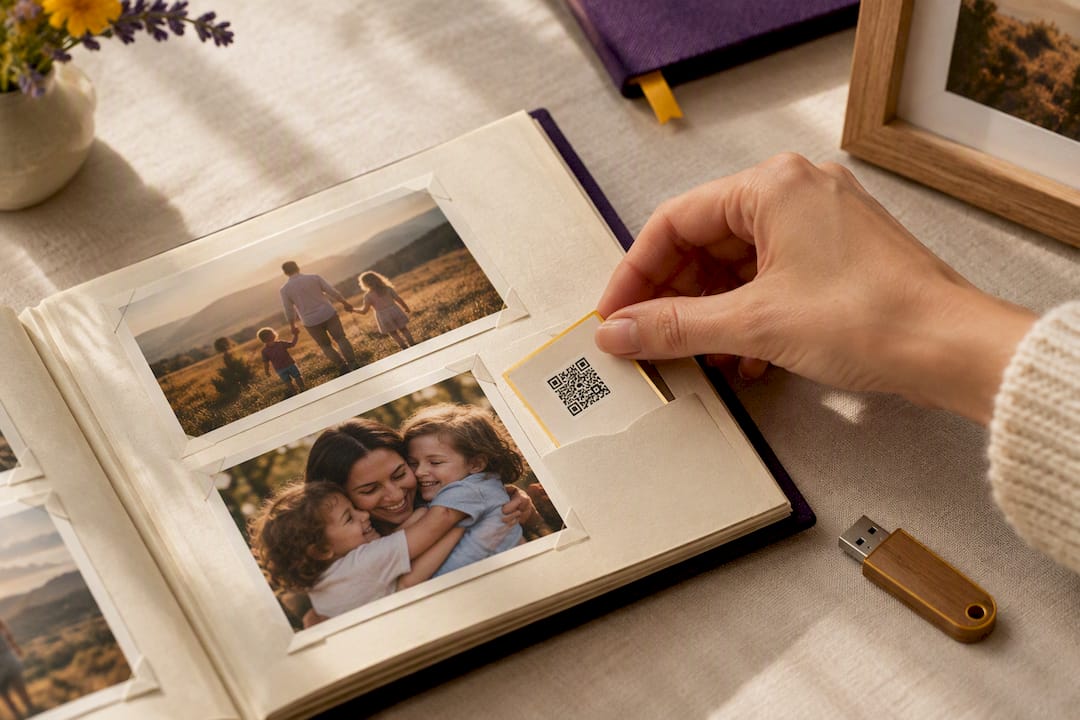
For a physical keepsake, a printed poster with a QR code turns an intangible audio file into something you can frame or tuck into a photo album. A USB drive labeled by hand works too, especially for older relatives who prefer something they can hold.
If the song involves a deceased family member or sensitive content, agree as a family on where it lives, a private group chat, a shared drive, before anyone posts it publicly. What feels like a beautiful tribute to one person can feel like an unexpected exposure to another if shared without asking first.
Why a Custom Family Song Sticks Around Longer Than Most Gifts
Most gifts fade into the background within a year. A song built from real memories tends to resurface, at anniversaries, at holidays, during a hard week, in a way a card or a bouquet never does. That staying power isn't sentimentality alone. The research on autobiographically salient music backs it up: personally meaningful songs produce measurably different responses than familiar-but-generic ones, which is the whole case for commissioning something specific rather than picking a song off a playlist.
What I'd tell any family sitting down to write a brief: don't polish the memory before you hand it over. The rough, specific, slightly embarrassing detail is usually the one that makes the final song feel real instead of generic.
— Vlad
Start Your Family Song With a Simple Brief
Dearsong turns a short list of memories into a finished, personal song, not a template with names swapped in. You choose a package, pay securely, then fill out a quick online form covering the recipient's name, the occasion, key memories, nicknames, mood, genre, and up to two reference songs. That's the entire input required on your end.
The Essential package costs a moderate fee for one original song of typical short length, delivered quickly after you submit your completed form, ideal for a birthday tribute or a quick reunion anthem. The Signature package costs more and adds priority faster delivery, two song versions to choose between, one free lyric rewrite, and a printable gift poster with a QR code, a better fit for weddings, anniversaries, or memorial pieces where you want the extra polish and a physical keepsake to hand someone. Full details on both packages are on the pricing page, and if your occasion is specifically a family milestone, the custom family song page walks through examples built the same way. Pick a package and submit your brief today; the delivery clock starts the moment your form is in.
Sources
- When songs cue memories: musical features predict the qualities of music-evoked autobiographical memories (PLOS ONE)
- Constructed music-evoked episodic memories (CoMEEMs) and personalized song recommendations (IJHCS)
FAQ
What Counts as a "Family Song" in This Context?
A family song here means a custom original track written from your own family's memories and details, not a recording chosen from an existing catalog. It's built from a brief you provide, covering names, memories, and mood, then delivered as a finished audio file.
How Long Does It Take to Get a Custom Family Song?
With Dearsong, the Essential package delivers within 24 hours of your completed form, and the Signature package delivers within 12 hours with priority handling. Delivery timing starts once you submit the song-details form, not at the moment of checkout.
How Much Does a Commissioned Family Song Cost?
Dearsong's Essential package is 35 USD one-off for one original song up to three minutes, and the Signature package is 89 USD one-off for two versions, priority delivery, one lyric rewrite, and a printable gift poster. Both are listed on the pricing page.
What Should I Include in My Brief for the Best Result?
Include the occasion, your relationship to the recipient, two or three specific memories, any nicknames or family phrases, the emotional tone you want, and one or two reference songs. Research on music-evoked memory shows that familiarity and genre are the strongest predictors of a good match between a listener and a song, so reference tracks matter more than long mood descriptions.
Can I Get Revisions if the First Version Isn't Quite Right?
Dearsong's Signature package includes one free lyric rewrite, which covers most requests for adjusting a line or detail. If you anticipate wanting more back-and-forth, the Signature package's two-version option gives you a built-in comparison before you decide.