
Commissioning an original first dance song gives you a piece of music written to your own story and sized to fit your dance, instead of a track borrowed from someone else's life. The practical next step is simple: settle on the mood you want and pick one reference song that captures it, then write down a few specific memories before you contact a composer.
TL;DR:
- A custom first dance song can be tailored with your personal details, memories, and preferred mood, making it uniquely meaningful to both partners.
- Commissioning a song allows full control over length, tempo, and ending style, and provides the option to request edits before delivery.
- Most couples aim for a performance length of two to three minutes, with edited versions made specifically for the dance floor to ensure proper pacing.
- The cost for a custom wedding song starts at $35 for the basic package, with faster, more flexible options available for urgent or complex requests.
- Most wedding venues are covered by licensing for playing commercial music, but owning the rights to an original commissioned song simplifies legal concerns and future usage.
Table of Contents
- Why a custom first dance song might be right for your wedding
- What to include in your song brief (the 1-page checklist producers need)
- Match song to dance style: meter, tempo, and approachable options
- Production and day-of logistics: edits, files, and rehearsal
- How commissioning from DearSong works
- Tips for choosing a song meaningful to both partners
- Legal considerations for playing copyrighted music at a wedding
- How to coordinate your first dance song with your wedding theme
- Alternative first dance ideas beyond traditional romantic songs
- Author perspective: craft notes from Vlad at DearSong
- Get your custom wedding song started
- FAQ
- Sources
Why a custom first dance song might be right for your wedding
A commissioned song ties its lyrics to your actual relationship: your names, your first date, and personal details only you understand. That kind of specificity is what makes a song feel irreplaceable rather than borrowed, and it tends to be what people remember years later when the song plays again at an anniversary.
There are practical advantages too. A song written for your wedding can be built to the length and tempo you actually need for dancing, rather than asking you to edit someone else's track down to size. You can also request changes before the final file ships, and the song can be delivered privately so it stays a surprise until the moment you want it revealed.
A bespoke song usually makes more sense when:
- Your story has specific details (a proposal location, a shared nickname, an inside joke) that an existing song could never reference.
- You want full control over length, tempo, and the exact ending.
- You'd rather keep the song private until the first dance itself.
A favorite existing song still works well when the track already carries years of shared meaning for you as a couple and changing a single word would feel wrong.
What to include in your song brief (the 1-page checklist producers need)
The clearer your brief, the closer the first draft lands to what you actually want. Before you commission anything, gather the following:
- Names, nicknames, and key dates: both your names, any pet names, your anniversary or proposal date.
- Two or three specific memories: a trip, a first conversation, a small habit that defines your relationship.
- Important places: where you met, where you got engaged, a city that matters to your story.
- Mood and genre: romantic ballad, acoustic folk, upbeat pop, slow soul, and so on.
- Voice preference: male, female, duet, or no strong preference.
- One or two reference songs, with a note on what you like about each: the melody, a lyric, the tempo, the overall feel.
- Target length and ending style: do you want the song to fade out, end on a held note, or close with a specific line.
- Lines to include or avoid: a phrase you want worked in, or a topic you'd rather skip entirely.
- Privacy and usage: whether the song stays private between you two or gets played publicly, and whether you need a commercial-use license.
Limiting yourself to one or two reference tracks, rather than a long list, helps a composer create a coherent musical direction instead of trying to blend five different styles into one song.
Pro Tip: Note one song for tempo and production style, and a second for vocal tone. Two focused references beat five scattered ones.
Match song to dance style: meter, tempo, and approachable options
Rather than picking a dance first and forcing a song to fit it, most experts advise starting with the song and the feeling you want, then matching your dance style to that song's meter, tempo, and overall character. A waltz needs a clear 3/4 meter; a foxtrot or nightclub two-step wants a steady 4/4 groove at a moderate pace; swing and bachata each want their own rhythmic pulse.
Once you know your song's character, you can map it to a realistic dance approach:
If your favorite song has an unclear beat or drifts in tempo, common solutions include editing the track by trimming the intro or shortening a meandering bridge, using a simple slow-dance frame instead of a set pattern, or pairing it briefly with a second, more danceable song.
When you commission a custom piece, you have an advantage here that a pre-recorded track doesn't offer: you can simply ask the composer for what you need.
- Request a steadier, more consistent tempo throughout if you're planning actual steps.
- Ask for a shorter intro so you're not standing still waiting for the vocal to start.
- Request a tightened verse or bridge if the full-length version runs too long for a performance.
Production and day-of logistics: edits, files, and rehearsal
A song that sounds great in headphones still needs to work on a wedding dance floor, which means thinking through length, file format, and timing well before the big day.
For length, practical guidance recommends keeping the performed first dance around two to three minutes, even if your full commissioned song runs longer. Ask for an edited or faded version sized for the dance itself, separate from the full-length version you'll keep as a keepsake.
Once you have your files:
- Request a high-quality MP3 or WAV and test it on an actual speaker, not just earbuds, before sending it anywhere.
- Confirm the exact start and stop points, and give your DJ written cue notes rather than a verbal description.
- Send the final file to your DJ at least a week before the wedding, never the morning of.
- Label the file clearly with the song title and target length so nothing gets mixed up on event day.
Pro Tip: Email your DJ the cue sheet and the audio file together, so the notes never get separated from the track.
Rehearsal matters as much as the file itself. Practice at least a few times in the shoes and the actual outfit you'll wear, since a flowing dress or stiff dress shoes change your footwork more than people expect. If you're attempting any real choreography beyond a sway, two or three lessons with an instructor in the weeks before the wedding are usually enough to build comfort without turning the first dance into a performance you're anxious about.

How commissioning from DearSong works
Commissioning a wedding song doesn't need to be complicated. At DearSong, the process runs in a short sequence: you choose a package and pay, then immediately fill out a short online form covering your story, your memories, your preferred mood and genre, and up to two reference songs. The delivery clock starts once that form is submitted, and you receive an MP3 download plus a private YouTube link.
The two packages differ mainly in speed and flexibility:
For a wedding, the extra speed and the two-version option in Signature can matter if your date is close or if you want to hear two creative directions before settling on the one you'll choose. You can read the full breakdown of what's included on the custom wedding song page or see the exact ordering steps on the how it works page.
Tips for choosing a song meaningful to both partners
A first dance song works best when both of you recognize something true in it, not just one partner's taste. Start by each naming one memory or detail that feels essential to your relationship, then look for the overlap rather than trying to force one person's favorite genre onto the other.
If your musical tastes genuinely differ, a commissioned song solves a problem a pre-recorded track can't: you can blend both of your references into one new piece, rather than picking a winner. Mention both of your preferred genres in your brief and let the composer find a middle ground, whether that's a folk melody with a soul vocal or an acoustic arrangement that nods to both styles.
Avoid cramming in every memory you've ever shared. A song built around one or two vivid, specific moments reads as more personal than a song that tries to summarize your entire relationship in three minutes. If you disagree about tone, lean toward the version of the song you'd both be comfortable hearing played in front of family, since that's realistically who will be in the room.
Finally, talk through how you want the song to end before you submit your brief. A fade-out feels cinematic and gives you an easy moment to simply stop dancing and hug; an ending on a sustained lyric line feels more dramatic and works well if you're planning a final dip or kiss timed to the music.
Legal considerations for playing copyrighted music at a wedding
If you're considering a pre-recorded commercial song rather than an original piece, most wedding venues and reception halls are already covered by blanket public performance licenses through performance rights organizations, which is why playing commercial music at a private reception generally isn't something individual couples need to clear themselves. Rules vary by venue and by country, so it's worth confirming with your venue or band what licensing they already carry.
Commissioning an original song removes most of this question entirely, since you're the one who owns the usage rights to the piece written for you. If you think you might want to use your song beyond the wedding itself, such as in a wedding video shared publicly, in social media content, or at a future event, it's worth asking about licensing terms for commercial use at the time you commission the piece rather than after the fact.
If you do go with a favorite existing commercial track for your first dance, keep any public sharing in mind separately: posting a wedding video with that song online can trigger different rules than playing it live at your reception, since platforms like social media sites often have their own copyright detection systems. An original commissioned song sidesteps that entirely, since there's no existing rights holder to flag it.
How to coordinate your first dance song with your wedding theme
Your first dance song is one of the few moments at a wedding where the music, the mood, and the visual setting all have to land together, so it's worth thinking about the song alongside your broader wedding theme rather than after it's finalized.
If your wedding leans rustic or outdoorsy, an acoustic arrangement with guitar or light strings will sit more naturally in that setting than a full orchestral ballad. A formal, black-tie reception often calls for something with more polish: strings, piano, a fuller arrangement. A beach or destination wedding might call for a lighter, breezier tempo that matches the setting rather than a heavy, dramatic ballad.
Lighting and timing matter too. If you're planning a choreographed moment, a change in lighting, or a surprise element like a dip or a costume reveal, mention that in your brief so the composer can build a short, stronger section, a chorus or bridge of around 20 to 30 seconds, that you can time your highlight moment to.
Think about when in the evening the dance happens as well. A first dance right after dinner, while the room is still settling, calls for something a little calmer than a first dance that kicks off the party later in the night. Mentioning the timing and the general tone of your reception in your brief helps the composer write something that fits the moment it's actually going to soundtrack, not just the story behind it.

Alternative first dance ideas beyond traditional romantic songs
A first dance doesn't have to be a slow, swelling ballad. Plenty of couples choose something upbeat, funny, or rooted in their cultural background, and a commissioned song can be written in any of those directions just as easily as a traditional love song.
An upbeat option works well for couples who met doing something active or who simply don't want a slow, formal moment in front of a room full of people. A commissioned song in a brighter pop or soul style, with a steadier 4/4 tempo, gives you something you can actually move to rather than sway through.
A humorous song can work too, especially for couples whose relationship has always run on inside jokes rather than grand romantic gestures. A composer can weave a running joke, a ridiculous nickname, or the story of an objectively unglamorous first date into something that still feels warm rather than silly.
Cultural and family traditions are worth folding in as well. If your families come from different backgrounds, a commissioned song can blend musical styles, languages, or instrumentation from both sides in a way a single existing commercial track almost never could. Mention any specific instruments, languages, or musical traditions you'd like represented when you write your brief, since this is exactly the kind of detail that makes a custom song worth commissioning in the first place.
Author perspective: craft notes from Vlad at DearSong
The briefs that produce the strongest lyrics are rarely the longest ones. One vivid memory, described specifically, gives a composer more to work with than ten vague ones. The most common pitfall I see is couples listing every memory they can think of instead of picking the one or two that actually define them, followed closely by leaving the ending unspecified and then being surprised by the final cut.
— Vlad
Get your custom wedding song started
A commissioned song gives you something no pre-recorded track can: lyrics built from your own story, sized to the length and tempo your dance actually needs. 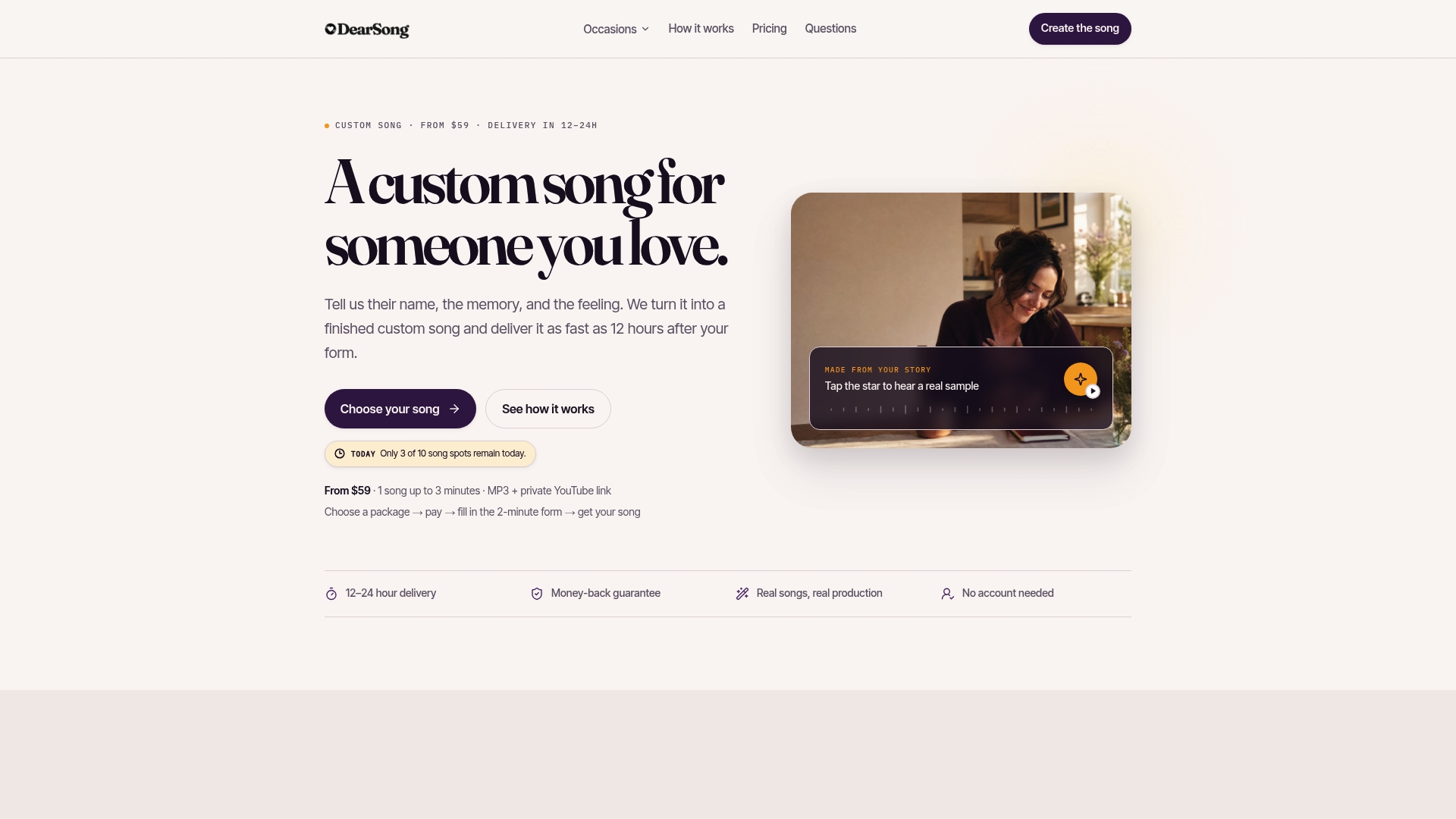
Every wedding song is written from a short brief you fill out after choosing a package, covering your story, your mood, and up to two reference tracks, with delivery in 12 to 24 hours depending on the package. Start on the custom wedding song page, or compare the Essential and Signature packages on our pricing page before you write your brief.
FAQ
What should I send when commissioning a first dance song?
Send both of your names, two or three specific memories, your preferred mood and genre, and one or two reference songs with notes on what you like about each. Mention your target song length and how you want it to end, whether that's a fade or a final lyric line.
How long should a first dance song be?
Most couples aim for a performed dance around two to three minutes, even when the full version of a commissioned song runs longer. Ask for a separate edited or faded version sized for the actual dance, and keep the full version as a longer keepsake.
What if our song doesn't have a clear dance rhythm?
If a meaningful song drifts in tempo or lacks a clear beat, common fixes include editing the track, using a simple slow-dance frame instead of set steps, or pairing it briefly with a second, more danceable song. A commissioned piece can also be written with a steadier tempo from the start if you mention that in your brief.
How much does a custom wedding song cost?
A custom wedding song starts from $35 for the Essential package, with delivery within 24 hours of your completed brief. The Signature package is $89 and adds priority 12-hour delivery, two song versions, a free lyric rewrite, and a printable gift poster.
Is it legal to play a copyrighted song at our wedding reception?
Most venues already carry blanket public performance licenses that cover playing commercial music at a private reception, though rules vary by venue and location. An original commissioned song sidesteps this question entirely, since you hold the rights to the piece written for you.
Sources
For deeper reading on matching songs to dance styles, editing tracks for performance length, and rehearsing with confidence, these resources go beyond what we cover here. A certified dance instructor can also help translate any song, commissioned or not, into steps that feel natural on the day.
- Wedding Dance Guide: First Dance Songs, Steps, Timeline & Practice Plan
- The Ultimate Guide to Choosing Your First Dance Song – Wedding Dance