
The best graduation song idea is not a track from a playlist. It is an original song written around the graduate's name, a specific memory, and the mood you want the moment to carry, delivered as an MP3 or private link within hours instead of weeks. Providers like DearSong build the song from a short brief you submit, with rush options for anyone ordering close to the ceremony.
TL;DR:
- Custom graduation songs are built from detailed briefs that include specific memories, nicknames, and mood; vague information results in less personal songs.
- Rush orders are available within 12 to 24 hours, but ordering early allows for revisions and a better match to the graduate’s personality.
- Songs tailored around a real scene or memory create stronger emotional recall than generic praise or broad themes.
- An ideal length for ceremony moments is 30 seconds to two minutes, while a longer standalone gift runs closer to three minutes.
- The most effective style and structure depend on the setting, with chorus repetitions of the graduate’s name and a single dominant emotion producing the best result.
Table of Contents
- What a custom graduation song is and why it works
- When to commission: timeline and pricing expectations
- How to write a song brief that gets a great result
- Choosing style, structure, and technical specifics
- Concrete song concept prompts and examples
- How to use the song at the event and in keepsakes
- Ordering process and what to expect from DearSong
- Why a song outlasts most graduation gifts
- DearSong: fast, personal graduation songs
- Sources
- FAQ
What a custom graduation song is and why it works
A custom graduation song is an original composition written from scratch: real lyrics built around the graduate's name, a memory or two, and a chosen mood and genre, then produced into a finished MP3 and a private streaming link. It is not a remix or a template with a name dropped in.
The reason it lands emotionally has a research basis. Music-evoked cues produce autobiographical memories with more episodic detail than the same memories triggered by photos, which is part of why a song can feel more personal than a slideshow or a card. A song built around one graduate does a few things a generic track cannot:
- It names the person directly instead of speaking in general terms.
- It references a specific scene, so the memory attaches to a melody.
- It gives the moment a soundtrack that did not exist before the occasion.
When to commission: timeline and pricing expectations
Timing depends on how fast you need the finished file and how much production and revision you want.
- Rush orders (12 to 24 hours): best for readers ordering the week of or the week before the ceremony, when you need a finished MP3 fast.
- Standard creative turnaround (a few days to a couple of weeks): gives more room for back and forth on lyrics if you are not in a hurry.
- Add-ons that extend time or cost: full band production, multiple lyric revisions, a lyric video, or a printed physical keepsake all add steps beyond the base song.
- Deadline planning for common uses: order at least two days before you need to load a slideshow track, at least a day before printing a program that references the song, and same-day if you only need the file for a phone speaker at a party.
Ordering earlier gives you room to request a rewrite if the first draft misses the tone you wanted. Ordering at the last minute still works with a rush package, but it leaves less room to adjust.
How to write a song brief that gets a great result
The brief is the single most important input. A vague brief produces a vague song, no matter how good the composer is. A specific one gives the writer real material to work with.
Include these fields:
- Full name and pronunciation, spelled out phonetically if it is easy to mispronounce.
- Two to four vivid scenes, not general praise: a specific hallway, a specific class, a specific late night studying.
- Nicknames that only close friends or family use.
- Mood and genre, described in a word or two: triumphant, wistful, funny, tender.
- One or two reference songs so the writer understands the sound you are picturing.
- Lines to avoid, such as inside jokes that would embarrass the graduate or nicknames they have outgrown.
Here is a sample brief you can adapt:
"Write a graduation song for Maya Chen, who everyone calls 'Mimi.' She just finished four years at Lincoln High and is heading to State University for engineering. Include the memory of us staying up until 2 a.m. the night before her AP exam, and the running joke about her terrible parallel parking. Mood: proud and a little emotional, not silly. Genre: acoustic pop, similar to something warm and simple. Please avoid any reference to her breakup last year."
Specificity matters because detailed, scene-based cues are what produce richer autobiographical recall when paired with music, so a real hallway or a real 2 a.m. study session will do more work than a line about being "proud of how far you've come."
Pro Tip: Write your two or three memories as if you were describing a movie scene: where you were, what happened, how it ended. That level of detail is what turns into a singable lyric.
Choosing style, structure, and technical specifics
Genre should match both the graduate's taste and the setting where the song will play.
- Anthemic indie pop fits a ceremony walk or a slideshow finale where you want a "we made it" lift.
- Acoustic ballad fits a quieter moment, like a private message from a parent.
- R&B works well for a smoother, more personal tribute from a partner or close friend.
- Playful children's pop fits younger siblings honoring an older sibling with humor.
For event use, aim for 90 seconds to two minutes for a cap-toss cue or slideshow loop, and closer to three minutes for a standalone gift the graduate keeps and replays. Tempo in the 105 to 122 bpm range tends to feel celebratory without rushing the lyrics.
Two structural choices consistently land well: a chorus that says the graduate's name outright, and a single, clear reference to the school or program rather than several competing details. Researchers at UC Berkeley have mapped at least 13 distinct emotions that music evokes, and choosing one dominant feeling, triumph or wistful pride, rather than trying to hit all of them, keeps a short song coherent.

Concrete song concept prompts and examples
Pick one of these and swap in real names, places, and details.
- Anthemic send-off: hook is "the world's about to know your name." Lyric seed: name the school hallway, name the dream. Tempo around 118 bpm, length 2:30.
- Nostalgic acoustic: hook is "four years, one story, and it's yours." Lyric seed: the first day of freshman year against the last. Tempo around 90 bpm, length 3:00.
- Comedic roast: hook is "you failed the parking test twice, but you nailed this." Lyric seed: one running joke, delivered with affection. Tempo around 110 bpm, length 2:00.
- Family tribute: hook is "we watched you grow from the front row." Lyric seed: a parent's specific memory of a school event. Tempo around 95 bpm, length 2:45.
- Indie send-off duet: hook is "same hallway, different roads now." Lyric seed: two best friends splitting for different colleges. Tempo around 105 bpm, length 2:30.
- Instrumental slideshow track: no lyrics, built around a melodic theme that repeats. Length 90 seconds, tempo around 100 bpm.
- Short cap-walk cue: hook is "here she goes." Lyric seed: one line naming the graduate as they cross the stage. Length 30 to 45 seconds.
How to use the song at the event and in keepsakes
The song works in more places than a single playback moment.
- Processional or cap toss: a short cue, 30 to 90 seconds, timed to the walk or the moment caps go up.
- Slideshow soundtrack: a full or instrumental version underneath photos, faded in at the start and out at the end.
- Party opener or surprise reveal: play the full song once, at a volume where lyrics are audible over conversation.
- Technical checklist: test the audio level on the actual speaker beforehand, use the MP3 for phones and speakers, and request an instrumental edit if you plan to speak over part of it.
- Keepsake presentation: a printable gift poster with a QR code linking to the song gives the graduate something physical to keep alongside the file.
Ordering process and what to expect from DearSong
DearSong's process is built around a short brief and a fast turnaround, which matches how most people are shopping for a graduation gift close to the date.
- Step one: choose a package and pay securely.
- Step two: complete a short online form covering the graduate's name, memories, nicknames, mood, genre, and up to two reference songs.
- Step three: the delivery clock starts once that form is submitted.
The Essential package is $59 and includes one original song up to three minutes, an MP3 download, a private YouTube link, and delivery within 24 hours of the completed form. The Signature package is $89 and adds priority delivery within 12 hours, two song versions to choose between, one free lyric rewrite, and a printable gift poster with a QR code. Readers ordering close to the ceremony or who want a backup version if the first draft misses the mark should lean toward Signature.
Why a song outlasts most graduation gifts

A framed photo fades into the background of a room. A song gets replayed on a hard year, a reunion, a random Tuesday. That is the real case for commissioning one: it keeps working long after the cap has been thrown.
My honest take is to spend the extra money for a second version and a rewrite if the budget allows it. A first draft rarely captures a whole relationship on the first try.
— Vlad
DearSong: fast, personal graduation songs
DearSong turns the brief you write into a finished song built entirely from the graduate's name, memories, and the mood you choose, not a generic template with a name swapped in. The Essential package delivers one song within 24 hours, and Signature delivers two versions with a free rewrite and a printable gift poster within 12 hours.
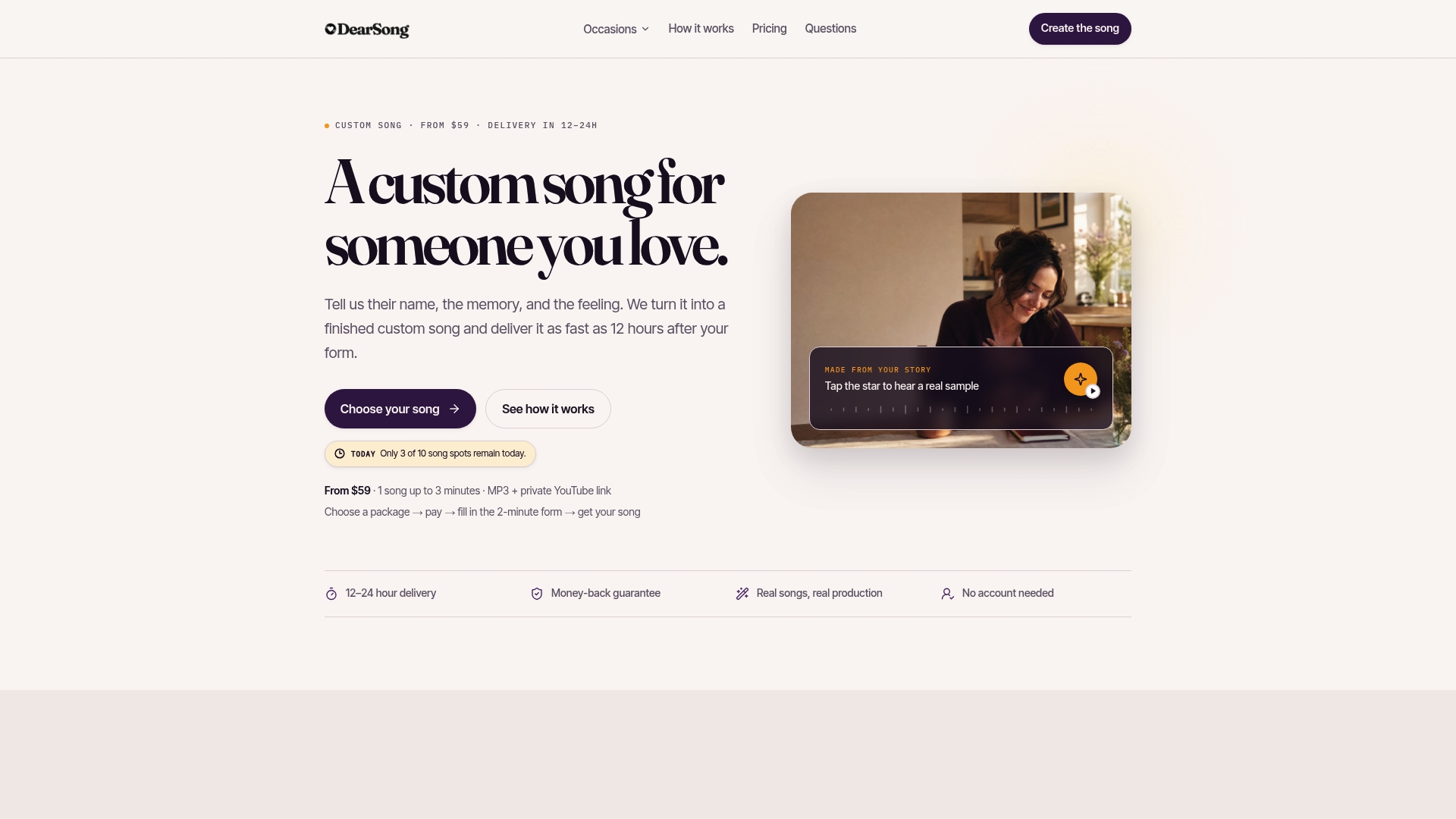
If you want to hear what the finished product sounds like before you commit, the samples page has audio examples across different genres and moods. For a family-focused tribute rather than a solo gift, the custom family song page walks through how shared memories become one song. When you are ready, check pricing and start your order.
Sources
Claims on memory and emotion draw from PubMed, UC Berkeley, and APA PsycNet.
- Music-evoked autobiographical memories are episodically rich (PubMed)
- Ooh là là! Music evokes at least 13 emotions. (UC Berkeley)
FAQ
What makes a graduation song idea feel personal instead of generic?
A song feels personal when it names the graduate directly and references a specific memory or place rather than general praise. Vague lines like "you worked so hard" apply to anyone, while a line about a real hallway or a real late night studying applies to exactly one person.
How long should a graduation song be?
For ceremony moments like a cap toss or a slideshow cue, 30 seconds to two minutes works best, while a standalone gift the graduate keeps typically runs closer to three minutes. Providers like DearSong deliver songs up to three minutes in the Essential package.
How fast can I get a custom graduation song?
Rush delivery windows of 12 to 24 hours are common once you submit a completed brief. DearSong's Signature package delivers within 12 hours, while Essential delivers within 24 hours of the completed form.
What information do I need to provide to order one?
You typically need the graduate's full name, one or two specific memories, any nicknames, a desired mood and genre, and up to two reference songs. This detail is what turns a template into a song that feels written for one specific person.
Can I get more than one version or request changes?
Some packages include a free lyric rewrite and multiple versions to choose from. DearSong's Signature package includes two song versions and one free lyric rewrite, while Essential includes a single finished song.