
Commissioning a love letter song is straightforward: gather a few real memories about the person, choose a package with a provider like DearSong, and you can have a finished, personal track in as little as 12 to 24 hours. The songwriting itself is handled for you. Your job is just to hand over the story.
TL;DR:
- Custom love letter songs can be commissioned within 12 to 24 hours if you choose a rush service, but standard delivery takes 5 to 14 days.
- Providing specific details, such as exact nicknames, shared memories, and reference songs, significantly improves the song’s emotional impact and reduces revision rounds.
- Most packages include one revision, with detailed feedback and timestamped notes earning about faster and better results.
- Files are typically delivered as MP3s and private YouTube links, while WAV files or stems involve additional costs and are suited for professional use.
- A commissioned love song works best when tied to a meaningful event and presented thoughtfully, increasing its lasting sentimental value.
Table of Contents
- How Does Commissioning a Love Letter Song Actually Work?
- What Personal Details Actually Make Lyrics Sing?
- What Should You Expect for Timing, Pricing, and File Delivery?
- How Do You Review a Draft and Give Feedback That Works?
- How Do You Present a Love Letter Song as a Gift?
- Where Did Love Letter Songs Come From?
- What Are Some Well-Known Love Letter Songs?
- How Do You Write Your Own Love Letter Song?
- What Themes Show Up Again and Again in Love Letter Songs?
- How Should You Actually Use a Love Letter Song in a Relationship?
- Why Concrete Stories Make Better Songs
- Ready to Turn Your Story Into a Song?
- Helpful Pages to Read Next
- FAQ
How Does Commissioning a Love Letter Song Actually Work?
A love letter song is a custom original track built around a real relationship instead of generic romantic lyrics pulled off a shelf. The process runs in a predictable sequence, and knowing the order helps you avoid the two most common mistakes: submitting a vague brief and waiting until the last minute.
- Pick a provider and package, then pay to start the project. This locks in your delivery window and gives the songwriting team a green light to begin.
- Fill out the song-details form. You'll enter the recipient's name, nicknames, the occasion, key memories, mood, musical genre, preferred vocal style, tempo, and up to two reference tracks.
- The creative team drafts the song. Depending on the service, you may get a rough demo first or go straight to a full draft, followed by one round of revision before the final master is rendered.
- You receive the finished files. Formats typically include an MP3 for sharing and sometimes a private YouTube link.
Turnaround speed depends almost entirely on which tier you choose. Standard commissioning across the market runs 5 to 14 days, while rush tiers compress that into 12 to 24 hours by prioritizing your brief in the production queue. The clock generally starts once you submit the completed form, not at checkout, so filling it out promptly matters more than people expect.
What Personal Details Actually Make Lyrics Sing?
Generic prompts produce generic songs. The difference between a track that feels like it was written for a stranger and one that makes someone cry in the first ten seconds comes down to specificity in the brief.
Songwriters work from what you give them, and vague adjectives like "loving" or "sweet" give them nothing to write toward. Concrete details do the heavy lifting: share sensory scenes, exact nicknames, and small habits rather than summary statements about how great someone is. "She always steals my hoodie on cold mornings" writes a better verse than "she's caring and warm."
A tight brief usually includes:
- The recipient's full name plus any nickname you actually use, with pronunciation notes if it's uncommon
- One or two specific memories with a place, a sound, or an object attached (a diner booth, a song playing in the car, a specific rainy afternoon)
- The mood you want (playful, tender, bittersweet) and the general length you need
- A musical genre and one or two reference songs so the arrangement has a sonic target
- Any words, inside jokes, or phrases the two of you actually say to each other
Pro Tip: Write down the pronunciation of any unusual name or nickname phonetically ("Kay-lee-ANN," not just "Kylianne"). A misheard name in the vocal take often means a costly re-record, while a two-second note up front avoids the whole problem.
Reference tracks matter more than most people realize. Handing the songwriter a song with the sound you're picturing cuts down revision rounds because it gives producers a target for tempo, instrumentation, and mix balance instead of leaving them to guess.
What Should You Expect for Timing, Pricing, and File Delivery?
Custom song pricing generally splits into two shapes: a single-song entry tier and a premium tier with extras built in. DearSong's Essential package runs $59 for one original song up to three minutes, delivered as an MP3 with a private YouTube link within 24 hours of your completed form. The Signature package, at $89, adds priority delivery within 12 hours, two song versions to pick between, one free lyric rewrite, and a printable gift poster with a QR code linking to the track.
What typically adds cost across the market:
- A second version or alternate arrangement of the same song
- Major revisions beyond what's included in your tier
- Requesting individual stems (separated vocal, instrument, and drum tracks) for remixing or live performance
Delivery formats vary depending on what you plan to do with the song. A 320 kbps MP3 works fine for texting or sharing, a private YouTube link is ideal for an easy playback moment, and full-quality WAV files or stems matter mainly if you're archiving the track long term or handing it to a DJ or editor for a video project.
Rush tiers exist because turnaround compresses production time significantly: standard custom orders across the industry run 5 to 14 days, so a 12 to 24 hour rush option is a real acceleration, not a marketing gimmick.
How Do You Review a Draft and Give Feedback That Works?
The fastest way to burn through your included revisions is vague feedback. "I don't love it" tells a producer nothing. Specific, structured notes get you a better song faster and keep you inside the revisions your package already covers.
- Listen on at least two devices — phone speaker and headphones catch different problems, especially with vocal clarity and mix balance.
- Mark exact timestamps for anything you want changed, rather than describing it in general terms.
- Phrase notes as direct edits. Producers respond better to specific, timestamped requests than vague impressions — "change 'always' to 'still' in the line at 1:12" beats "the second verse feels off."
- Ask about tempo or energy shifts precisely. "Pick up the tempo starting at 0:42" gives a producer something they can act on immediately.
- Confirm what's included before you ask for changes. Most packages cover one round of revision; anything past that scope, like a full rewrite or a new vocal take, may carry an added fee.
Pro Tip: Send your feedback as a short numbered list with timestamps attached to each point. It reads faster for the production team and almost always means fewer revision rounds than a paragraph of impressions.
How Do You Present a Love Letter Song as a Gift?
The song itself is only half the gift. How you reveal it often becomes the memory people talk about years later.
Presentation depends on the occasion and the personality of the recipient:
- A quiet, private listening moment works for a partner who'd rather not have an audience: hand over headphones or play it through a speaker in a familiar room.
- A first dance or reception moment turns a custom wedding song into a shared experience for everyone in the room, not just the couple.
- A recorded message played at an event lets you cue the song right after a toast or announcement for maximum impact.
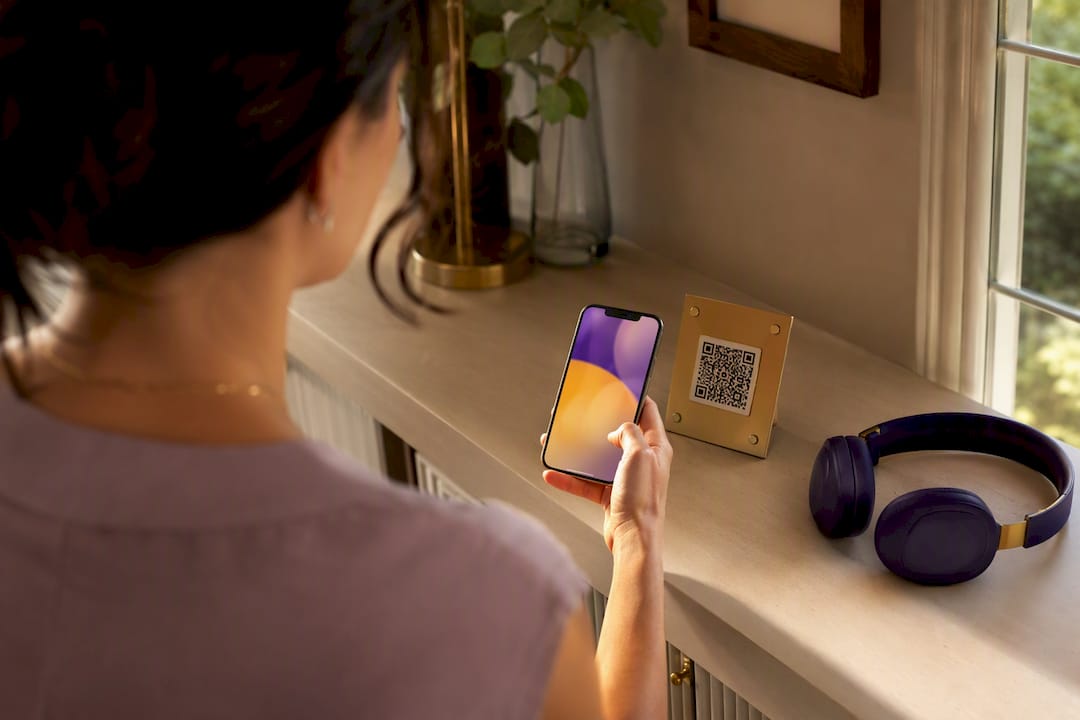
- A lyric poster with a QR code gives the recipient something physical to hang and replay whenever they want, which is exactly why DearSong's Signature package includes one.
- Embedding the track into a video slideshow works well for anniversaries or milestone birthdays where you're already gathering photos.
Timing matters as much as format. Introduce the song briefly before playing it. One or two sentences about why you commissioned it, without over-explaining the lyrics, lets the recipient discover the details themselves instead of having the moment spoiled.
Where Did Love Letter Songs Come From?
Setting personal devotion to music predates recorded sound by centuries. Troubadours in medieval France wrote and performed songs of courtly love for specific patrons and lovers, often naming them directly in verse. The tradition carried through folk ballads, where a singer would compose a tune about a real person in the community, and into the Tin Pan Alley era, when songwriters were routinely hired to write personalized numbers for weddings and anniversaries.
What's changed isn't the impulse, it's the access. For most of history, commissioning a song required knowing a composer or being wealthy enough to hire one. Today, an online brief and a payment form do the same job a patron's letter once did. The significance hasn't shifted: a love letter song still works because it proves someone spent real effort translating a private relationship into something the recipient can keep and replay, rather than picking a pre-written card off a rack.
That's also why the format keeps showing up at weddings, anniversaries, and memorials specifically. Those are the moments where generic gestures feel inadequate and specific ones carry the most weight. If you've ever wondered why a love letter, written in actual words on paper, still means more than a text, a personalized song works on the same principle with an added advantage: melody and rhythm make details stick in memory far longer than prose does.
What Are Some Well-Known Love Letter Songs?
Nearly every genre has its own version of the love-letter song, and looking at a few makes it easier to picture what genre and mood you might request in your own brief.
In classic soul and R&B, songs built around direct, confessional lyrics addressed to a specific person set the template: a singer speaking plainly to one listener rather than an abstract audience. Country music leans on this format constantly, often naming places and small domestic details (a truck, a porch, a specific town) instead of generic romantic imagery. Folk and singer-songwriter traditions favor sparse instrumentation that puts the lyrics front and center, which is part of why acoustic guitar remains one of the most requested reference styles for custom love songs.
Pop ballads tend toward big, universal emotional statements, which work well for weddings where the crowd needs to connect even without knowing the couple's private history. Hip hop and R&B collaborations have produced entire tracks structured as spoken-word love letters set to a beat, proving the format isn't locked to any one instrumentation.
The throughline across all of them: the strongest examples never rely on abstract praise. They anchor the emotion in something specific, a scent, a shared joke, a first meeting, which is exactly the ingredient a custom commission needs from you in the brief.
How Do You Write Your Own Love Letter Song?
If you're tempted to write the lyrics yourself before handing them to a producer, or you just want to understand what makes a good one, start with a single scene rather than a list of feelings. "I love how you laugh at your own jokes before you finish telling them" gives a listener more than three verses of adjectives ever could.
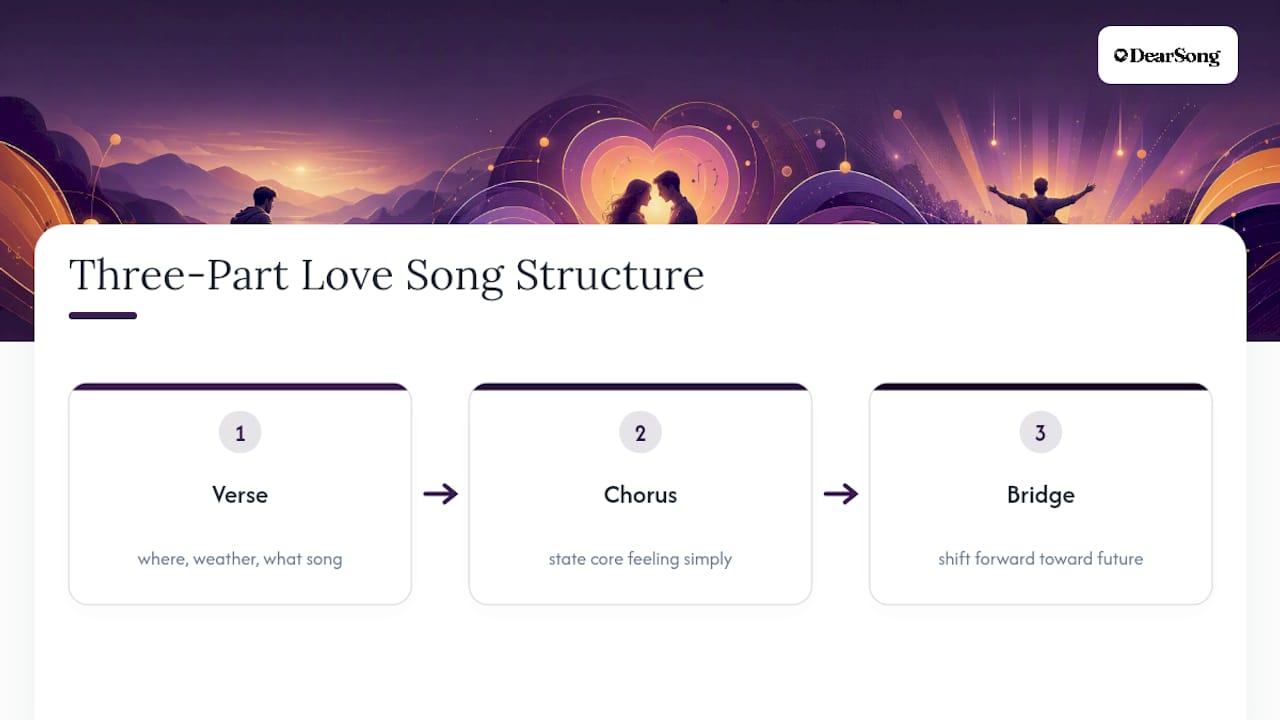
Pick one moment and build outward from it. A first verse can set a scene (where you met, what the weather was like, what song was playing), the chorus can state the core feeling in the simplest words you'd actually say out loud, and a bridge can shift the perspective forward, toward what you hope comes next.
Avoid rhyming for its own sake. Forced rhymes are the fastest way to make a heartfelt lyric sound like a greeting card. If the natural word doesn't rhyme, let the line be unrhymed or restructure the phrase instead of reaching for a word that breaks the tone.
Read your draft aloud before you judge it. Lyrics live in the mouth and ear far more than on the page, and a line that looks fine written down sometimes stumbles the moment you try to sing it. If you get stuck, borrow the same trick professional songwriters use: describe the person to a friend for two minutes without thinking about rhyme or structure, then go back and pull the sentence that made your friend react. That sentence is usually your best lyric.
What Themes Show Up Again and Again in Love Letter Songs?
A handful of motifs recur across nearly every love letter song, and recognizing them helps you decide what to lean into, or avoid, in your own brief.
Time and permanence shows up constantly: promises to stay, references to growing old together, or callbacks to "the first time" and "still, after all this time." Small domestic details work as shorthand for intimacy, a shared coffee order, a specific route home, the way someone folds laundry, because they signal real familiarity rather than performed romance.
Distance and longing appear whenever the song addresses someone far away or unavailable, often built around waiting, letters, or phone calls. Gratitude framed as surprise is common in songs meant to say something the writer never said out loud, the "I don't tell you this enough" angle that makes memorial and anniversary songs land hard.
Sensory anchors, a scent, a specific song, a particular light at a certain hour, do more work than abstract praise ever will. Songwriters consistently reach for the concrete image over the vague compliment because specific details are what make a lyric feel earned rather than generic. If you've ever seen a love letter emoji used to cap off a text, it reflects the same instinct: a small, specific symbol standing in for a much bigger feeling.
How Should You Actually Use a Love Letter Song in a Relationship?
A finished song is only as good as the moment you build around it. The most common mistake is treating the file like an afterthought, forwarding it in a text with no context, instead of treating the reveal itself as part of the gift.
Use timing deliberately. A song works best tied to a specific occasion, an anniversary, a proposal, a reunion after distance, rather than dropped into an ordinary Tuesday with no framing. The occasion gives the recipient a reason to actually stop and listen instead of half hearing it in the background.
Consider repeat value, not just the reveal. A love letter song that stays in rotation, on a shared playlist, as a ringtone, at the next anniversary, keeps paying off long after the initial surprise fades. That's part of why formats like a printed lyric poster or a keepsake QR code matter: they turn a one-time listen into something the recipient can return to.
Don't oversell it beforehand. Telling someone "I made you something incredible" before hitting play raises expectations in a way that can undercut the moment. Let the song's specificity do the persuading. A well-written verse about a real shared memory needs no introduction beyond "I made this for you."
Finally, treat it as a supplement to saying things directly, not a replacement. A song can carry weight that a spoken sentence can't, but the people who get the most out of this format still tell their partner or family member how they feel in plain words too. The song becomes the thing they replay; the words are what they remember hearing first.
Why Concrete Stories Make Better Songs
Most people commissioning a song for the first time assume the songwriter needs their feelings. They don't. They need your scenes.
Feelings are the same for everyone. "I love her" and "I'm grateful for him" could describe a million relationships. What a songwriter actually needs is the one detail that couldn't belong to anyone else: the specific diner booth, the exact nickname only you use, the joke that only makes sense because of one dumb road trip in 2019. That's the raw material lyrics are built from, and it's the single biggest lever you control in this whole process.
I'd rather see a brief with three messy, half-formed memories than one polished paragraph about how wonderful someone is. The messy version gives a writer somewhere to start. The polished version gives them nothing to work with except clichés. If you're staring at a blank brief form wondering what to write, skip the summary of the relationship entirely and just describe one Tuesday you remember clearly. That's usually the whole song, right there.
— Vlad
Ready to Turn Your Story Into a Song?
You could spend a weekend trying to write and record something yourself, or hand a vague request to a general freelance musician and hope they get it right. DearSong skips both problems: you fill out one brief, and a finished, professionally produced track lands in your inbox within 12 to 24 hours.
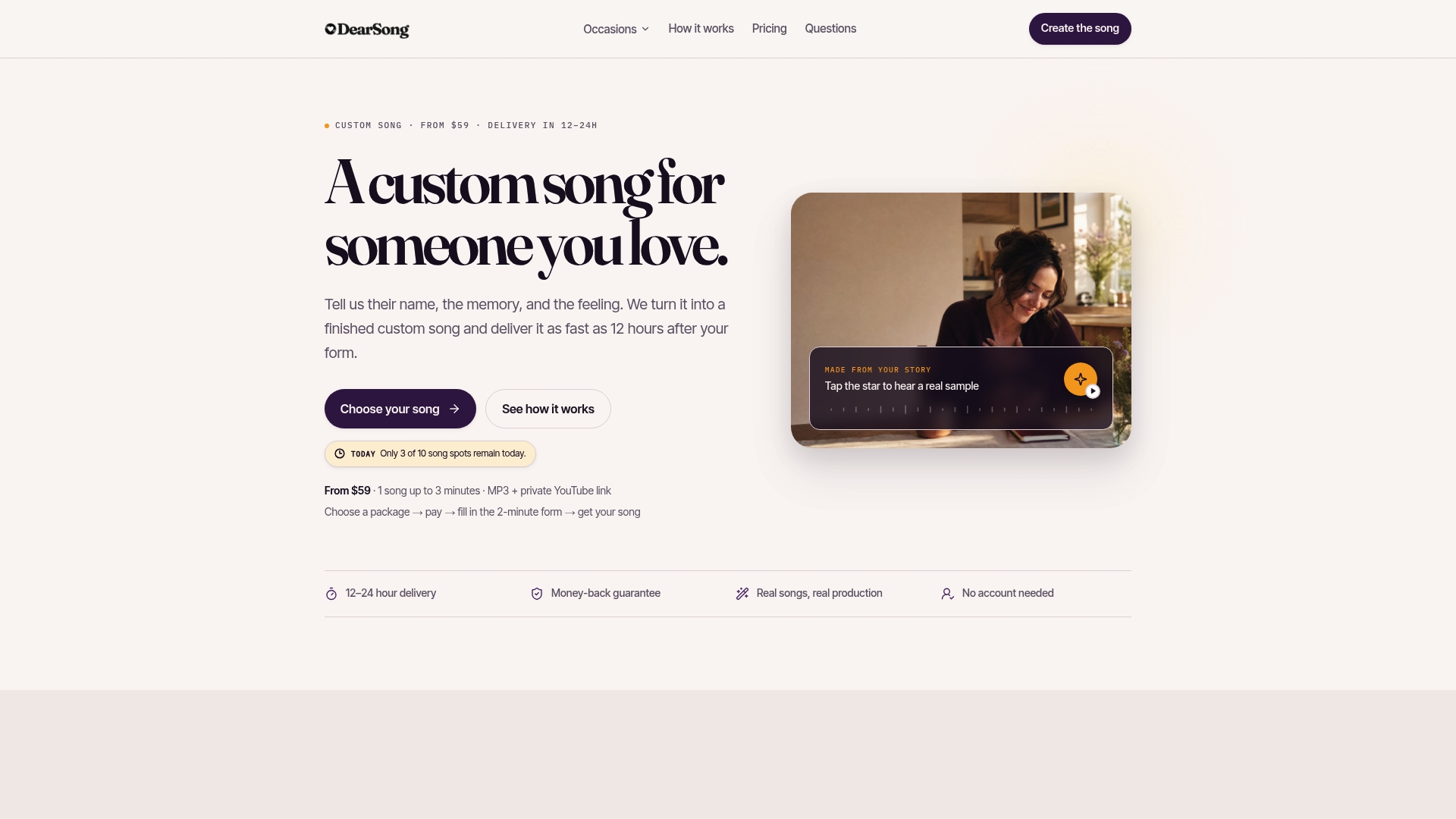
The Essential package covers one original song up to three minutes, delivered as an MP3 with a private YouTube link, for $59 within 24 hours of your completed form. Signature, at $89, adds priority delivery in 12 hours, two versions to choose between, one free lyric rewrite, and a printable gift poster with a QR code. Ordering takes three steps: pick a package and pay, complete the song-details form with the names and memories that matter, then wait for your finished track to land. Whether the occasion is a proposal, an anniversary, or a first dance, check full pricing details and start your brief today.
Helpful Pages to Read Next
Ready to move from planning to ordering? Start with DearSong's main page for an overview, review how the process works step by step, or browse pricing before you commit. For a lighter look at how a written love letter turns into a symbol of its own, the love letter emoji guide is worth a glance.
FAQ
How Long Does It Take to Get a Custom Love Letter Song?
Standard custom orders across the market run 5 to 14 days, but rush tiers like DearSong's Signature package deliver in as little as 12 hours after you submit your completed brief.
What Information Do I Need to Provide?
You'll need the recipient's name and nicknames, one or two specific memories, your desired mood and genre, and up to two reference songs so the producer has a clear sonic target.
How Much Does a Custom Love Letter Song Cost?
Pricing typically splits into a single-song entry tier and a premium tier with extras. Pricing typically includes a lower-priced single-song option and a premium option offering multiple versions, lyric rewrites, and gift posters.
Can I Request Changes After I Hear the First Draft?
Most packages include one round of revision, and giving timestamped, specific feedback like "change the line at 1:12" gets better results than general impressions and helps you stay within that included revision.
What File Formats Will I Receive?
You typically get an MP3 for sharing plus a private YouTube link, while WAV files or stems are usually reserved for archival storage or professional remixing needs.
Is a Commissioned Song a Good Gift for a Wedding or Anniversary?
Yes. A custom song built around a couple's actual story works well as a first dance, a proposal soundtrack, or an anniversary keepsake, since the specific details make it feel personal rather than generic.