
A meaningful memorial song is one built from a single vivid memory and a name, not a list of accomplishments read in verse. Start now: write one sentence beginning "I remember..." and note the person's name, your relationship, and the tone you want, tender, celebratory, or plainspoken. That sentence is the seed a songwriter or service like DearSong needs to build the rest.
TL;DR:
- Gathering five specific details about the person, such as their nickname, a vivid memory, and three descriptive words, helps create a meaningful memorial song.
- Short exercises like a five-minute grief-writing prompt or object-based writing can produce authentic lyric lines without requiring advanced songwriting skills.
- The song’s structure and tone should match where it is performed, whether a brief service tribute, a group sing-along at a reception, or a private reflection.
- The length of the song varies from 60 seconds for a spoken tribute to three minutes for a listening piece, and testing playback beforehand avoids technical issues.
- Costs range from around 35 to 89 USD, depending on turnaround, revisions, and extras, with rights generally reserved by the writer or service but personal use included.
Table of Contents
- Memorial Song Ideas: What Five Details Get You Started
- What Writing Exercises Produce Real Lyric Lines?
- Which Song Structure and Tone Fit Your Service?
- How Long Should the Song Be, and How Do You Share It?
- Three Templates You Can Adapt Right Now
- Do You Own the Rights to a Commissioned Memorial Song?
- Where Does a Memorial Song Fit in the Service?
- How Do You Choose a Vocalist or Musician?
- What Does a Custom Memorial Song Typically Cost?
- Writing With Cultural and Emotional Care
- Why Commissioned Songs Endure as Keepsakes
- Commission a Custom Memorial Song With DearSong
- Sources
- FAQ
Memorial Song Ideas: What Five Details Get You Started
Most people freeze when asked to write about someone they lost, because they try to say everything at once. Songwriters need the opposite: a handful of specific, narrow details rather than a eulogy. Gathering five things before you write, or before you fill out a commissioning form, turns a vague ask into a workable brief.
Each detail does a different job. The name or nickname anchors the lyric so it never sounds generic. A single vivid memory gives the songwriter the image to build a verse around, and prompt-based writing exercises that start from one concrete memory consistently produce stronger lyric material than trying to summarize a whole life. Three descriptive words (warm, stubborn, funny) set the emotional register. Naming the setting, a service, a slideshow, or private listening at home, shapes length and tone. The stance you want, whether defiant or gentle, tells the writer how hard to lean into grief versus gratitude.
Copy this into a note or email before you write a line:
- Name or nickname the person actually went by
- One specific memory (a place, a habit, a phrase they always said)
- Three words that describe them
- Where the song will be used (service, slideshow, private listening, reception)
- The emotional stance you want (tender, celebratory, defiant, plainspoken)
Pro Tip: Pick one concrete image, like "she always had flour on her hands" instead of "she loved to bake." A songwriter can build a whole verse around flour on her hands. "She loved to bake" gives them nothing to hold onto.
What Writing Exercises Produce Real Lyric Lines?
You do not need to be a writer to produce usable lines. You need a timer and permission to write badly for five minutes.
- The five-minute "I remember" prompt. Set a timer and write "I remember..." followed by whatever comes, no editing. Grief-writing guides recommend this exact exercise because it bypasses the urge to summarize and forces specificity.
- The object-as-character prompt. Pick one object tied to the person, their truck, a coffee mug, a fishing rod, and write three sentences about what it saw or knew.
- The sound prompt. Write down a sound you associate with them: a laugh, a specific song they hummed, the creak of a screen door.
- The six-word chorus challenge. Try to compress the entire feeling into six words. "You're still the loudest in the room" works better than a full stanza.
Two templates turn these scraps into an anchor line fast:
- "You always/never ___" (expand into a verse describing the habit and how it shaped a memory)
- "I still hear/see/smell ___ when ___" (expand into a verse tying a sensory detail to a specific moment)
To build a full outline: write your "I remember" sentence, pull the strongest phrase from it as your chorus line, then write two verses, one about a specific memory and one about what's missing now.
Which Song Structure and Tone Fit Your Service?
The right shape depends entirely on where the song plays and who's listening. A song read aloud during a service needs different bones than one played quietly at home months later.
- Service-friendly short form. One verse, one chorus, maybe a short repeat. Keeps the moment tight and lets emotion land without dragging.
- Sing-along chorus for a reception. A simple, repeatable chorus that a room full of non-singers can join on the second pass. Celebration-of-life songs work best when specific, sometimes wry verses sit against a short, comforting chorus that states one plain emotional promise.
- Intimate listening piece. Longer, more interior, built for headphones or a quiet room rather than a crowd.
Tone follows the same logic. Tender suits a spouse or parent's service. Celebratory fits someone who lived loudly and would have wanted laughter. Defiant works for a life cut short or a fight the person waged. Plainspoken, no metaphors, just facts, suits families who find flowery language distancing rather than comforting.
If non-musicians will sing along, keep the melody simple and the chorus short with a comfortable vocal range. Wide melodic leaps sound great on a recording and fall apart in a room full of grieving relatives trying to sing.
How Long Should the Song Be, and How Do You Share It?
Length depends on where the song fits into the day. A spoken tribute segment works best around 60 to 90 seconds, long enough to land, short enough not to stretch a service. A slideshow or private listening piece can run up to three minutes without losing the room.
- Choose your format. MP3 works for nearly every phone, laptop, or venue sound system. WAV is worth requesting only if a professional AV team is handling playback.
- Test playback ahead of time. A song that sounds full through headphones can thin out badly on a venue's speakers, so do a quick check the day before if possible.
- Decide who hears it first. Play the draft for one or two close family members before the service. Hearing the song in advance avoids a tone mismatch between what was written and what the room actually needs that day.
- Build in turnaround time. If you're commissioning rather than writing it yourself, a 12 to 48 hour delivery window still leaves room to preview, request a tweak, and share the final file before the event.
Pro Tip: Send the finished song to whoever is running the sound system at least a day early, not the morning of. Tech rehearsals catch volume and file-format problems that panic doesn't fix well.
Three Templates You Can Adapt Right Now
Templates work because they give you the skeleton so you only have to fill in what's true about your person. Below are three shapes, each suited to a different setting, plus two quick examples showing how the same skeleton flexes around different details.
- Template A: short verse + one-line chorus (service-friendly). Verse: describe one specific memory in four lines. Chorus: one repeatable line stating what you'll carry forward. Example: "You kept the porch light on for strays and for us / Now the light's still on, just quieter now" leading into a chorus like "We'll keep the light on, just like you taught us to."
- Template B: repeatable chorus for group singing (reception). Verse: a short, almost conversational memory. Chorus: simple, four to six words, easy to pick up on a second listen. Works well for someone who loved a crowd.
- Template C: intimate, interior piece (private listening or anniversary). No big chorus hook, more like a letter set to melody, built for one listener at a time rather than a room.
Swapping details is what makes each template personal rather than generic. Change "porch light" to "kitchen radio" or "workshop lamp" and the entire emotional anchor shifts while the structure holds. The same micro-template approach scales whether you're writing for a parent, a sibling, or a lifelong friend.
Do You Own the Rights to a Commissioned Memorial Song?
Copyright on a commissioned song typically belongs to whoever wrote it unless the commissioning agreement transfers those rights to you. Most reputable custom-song services build personal-use rights into the purchase price, meaning you can play the song at a service, share it privately, or post it for family, but the underlying composition may still legally belong to the writer or the service.
Read the terms before you commission, especially around three points: whether you can re-record the song with a different vocalist later, whether you can post it publicly on social media without restriction, and whether the service retains any right to reuse the melody or lyrics elsewhere. Personal memorial use is almost always covered without extra cost, but commercial use, a public memorial video monetized on YouTube, for instance, sometimes requires a separate license.
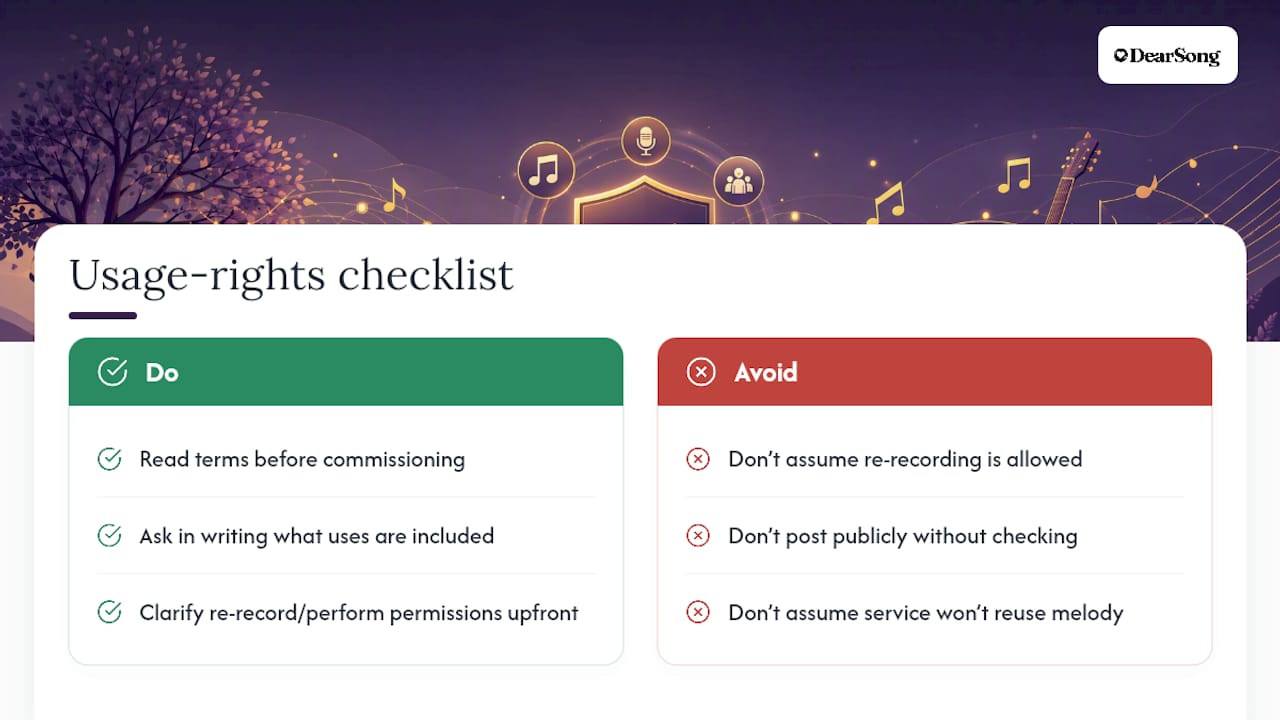
If a family member wants to perform the song live at a future gathering or have a different singer record it, clarify that up front rather than assuming it's automatically allowed. Most services are flexible about this when asked directly, since the whole point of a memorial song is for the family to keep and use it. The safest move is simply asking the service in writing what usage is included before you pay, so there's no ambiguity months later when someone wants to play it at an anniversary gathering.
Where Does a Memorial Song Fit in the Service?
An original memorial song doesn't need to replace anything the family already loves. It works best as an addition, not a substitute for a song the deceased was known for humming in the kitchen.
For a religious or traditional funeral service, a short version works well right before or after the eulogy, giving mourners a moment to sit with the words rather than move straight to the next program item. For a celebration of life, which tends to be looser and more social, the song fits naturally into a photo slideshow or as background during a reception, where guests can absorb it without the room needing to go silent.
If there's no obvious existing song tied to the person, an original piece can anchor the whole tribute rather than competing with a favorite track. If the family already has a song that meant everything to the person, consider playing the new commissioned piece afterward, as a coda rather than a replacement, so both hold their place.
Smaller, at-home gatherings offer more flexibility. A quiet listening moment after dinner, or a shared link sent to family members who couldn't travel, lets people experience the song on their own time, away from the emotional pressure of a live room. Outdoor scattering ceremonies or graveside moments tend to favor a short, spoken-word-adjacent version rather than a full arrangement, since ambient noise and weather make longer, more musically dense pieces harder to hear clearly.
How Do You Choose a Vocalist or Musician?
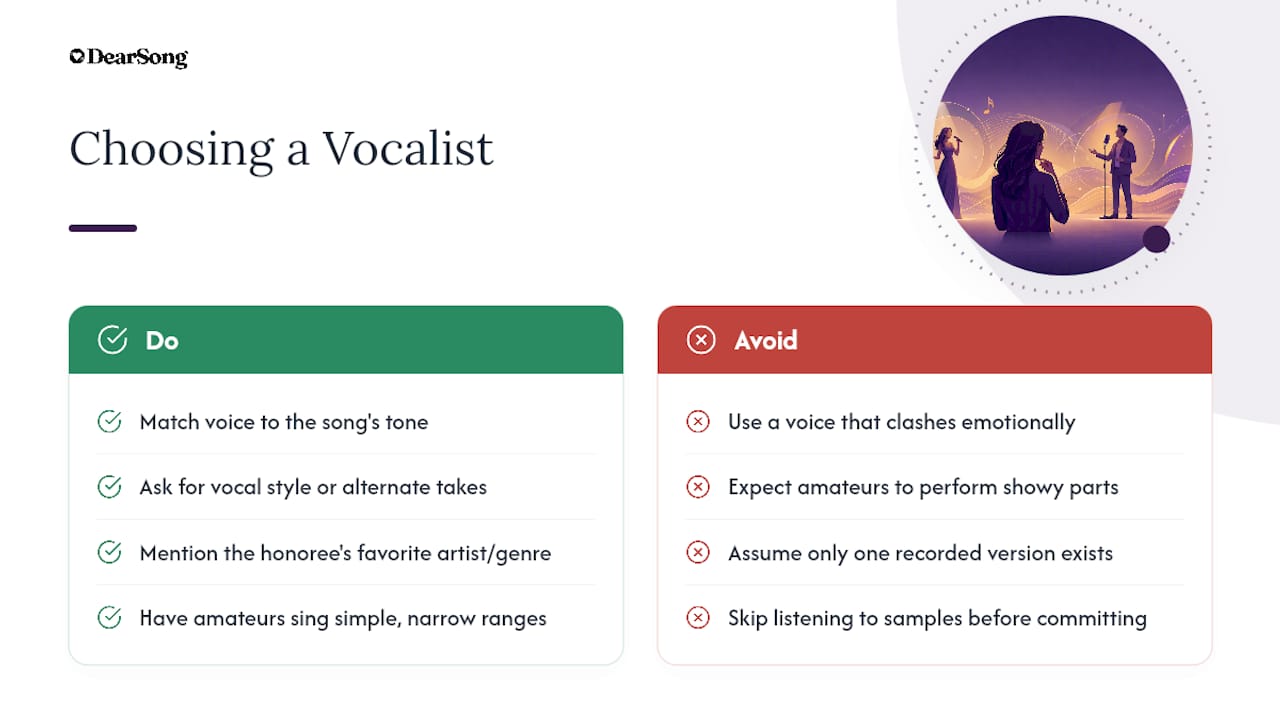
If you're commissioning a song rather than performing it yourself, the vocalist matters as much as the lyrics. A voice that doesn't match the emotional register of the piece can undercut even a beautifully written song.
Match the voice to the tone you settled on earlier. A tender, plainspoken piece usually calls for a warmer, less technically showy vocal, someone who sounds like they're speaking to you rather than performing for a stage. A celebratory or defiant piece can carry a bigger, more textured voice without it feeling out of place. If the person being honored had a favorite genre or artist, mentioning that reference point gives a vocalist or producer something concrete to aim for, rather than guessing at your taste from scratch.
If a family member or friend wants to sing live at the service instead of using a recording, be realistic about their comfort level under pressure. A simple, narrow melodic range with a short chorus, the kind built for singability rather than vocal display, gives a nervous amateur singer a far better shot at getting through it without cracking. Professional services that write and record the song usually offer a choice between vocal styles or two different takes, which is worth asking about directly rather than assuming only one version is available. Listening to a few sample recordings before committing helps confirm the voice actually fits what you pictured when you wrote your first "I remember" line.
What Does a Custom Memorial Song Typically Cost?
Costs for a commissioned memorial song vary by how much customization, how many revisions, and how fast you need delivery. Entry-level custom song services generally start in the range of several dozen dollars for a single finished track with standard turnaround, climbing higher for rush delivery, multiple versions, or added extras like a printable lyric sheet.
What you're really paying for is the songwriter's time translating your memory into something singable, plus the production and vocal recording that turns lyrics into a finished, shareable track. Faster turnaround and extra revisions cost more because they require more hands-on attention from the writer and production team, not because the base songwriting process changes.
Budgeting for a memorial song, whether through DearSong or any other provider, comes down to answering three questions honestly: how fast do you need it, do you want more than one version to choose from, and do you want physical or shareable extras like a printable poster. Answering those upfront, rather than mid-process, keeps the final price predictable instead of accumulating add-ons you didn't plan for.
Writing With Cultural and Emotional Care
Grief doesn't follow one script, and neither should the song written for it. Some families want a song that leans fully into sorrow. Others actively want humor, inside jokes, or a defiant, life-affirming tone that resists sentimentality altogether. Neither instinct is wrong, and a good songwriter should ask which direction you want rather than assuming.
Cultural and religious background shapes what feels appropriate more than most people expect going in. Some traditions favor plain, unadorned language over metaphor. Others welcome religious references or specific hymns woven into the melody. If the person being honored belonged to a specific faith or cultural community, mention that directly in your brief rather than leaving the songwriter to guess at tone from general details alone.
Be equally thoughtful about who else will hear the song. A verse that's deeply personal or slightly irreverent might feel exactly right to immediate family and jarring to extended relatives or colleagues at a formal service. If you're unsure how a specific line will land, ask a second family member before finalizing anything, and consider two versions, one for the public service and one just for close family, if the tone needs are genuinely different. There's no obligation to choose only one emotional register. A song can hold both grief and a laugh in the same three minutes, and often that's exactly what makes it feel true to the person it's for.
Why Commissioned Songs Endure as Keepsakes
Specificity is what makes a song outlast the day it was written for. A generic tribute fades because there's nothing to hold onto, but a line built from a real habit, a real object, a real phrase someone actually said, keeps working years later because it's tied to something concrete rather than a feeling everyone shares. That's the entire argument for narrowing down to one memory instead of trying to cover a whole life in three minutes.
What families tend to keep isn't the polish. It's the accuracy, the moment a lyric captures something so precisely that it feels like the person wrote it themselves. That's worth more than a technically flawless melody with nothing specific inside it.
— Vlad
Commission a Custom Memorial Song With DearSong
This service provides an alternative to hiring a freelance composer or writing the song yourself when you want something personal but don't have weeks to spare. You provide the memory, the name, and the tone, and a finished song comes back in 12 to 24 hours instead of the weeks a custom composer typically needs.

Two packages cover most memorial needs. The Essential package is an entry-level option suitable for standard memorial song needs, delivered promptly after your completed form, ideal if you're working against a tight service date. The Signature package runs $89 and adds priority 12 hour delivery, two song versions to choose between, one free lyric rewrite, and a printable gift poster with a QR code, worth it if you want a second opinion on tone before locking in the final version. Full details live on the pricing page.
The process itself takes three steps: pick a package, fill out a short song-details form with the name, memory, mood, and genre you settled on earlier, and then receive and approve the finished track. If you're ready to turn that "I remember" sentence into something you can actually play at the service, start your memorial song today.
Sources
- Funeral
- How to Write a Song About Celebration Of Life - Lyric Assistant
- Can You Have a Custom Song Written for a Memorial? (2026) | My Video Gift
FAQ
What Makes a Good Memorial Song Idea?
A good memorial song idea starts with one specific memory rather than a general summary of someone's life. Details like a habitual phrase, a place, or an object they loved give a songwriter, or a service like DearSong, the material to build a verse that actually sounds like the person.
How Much Does a Custom Memorial Song Cost?
DearSong's Essential package costs 35 USD one-off for one song, while the Signature package costs 89 USD one-off and adds a second version, a free lyric rewrite, and 12 hour delivery, according to the pricing page. Other custom-song services vary based on turnaround speed and extras requested.
How Long Should a Funeral Tribute Song Be?
A song meant for a spoken tribute segment during a service works best at 60 to 90 seconds, while a slideshow or private listening piece can run up to three minutes. Length should match where in the service the song plays, not the other way around.
Can I Use a Commissioned Song Instead of a Popular Funeral Song?
You can, but it usually works better alongside an existing song the family already loves rather than replacing it entirely. If there's no established song tied to the person, an original piece can anchor the tribute on its own.
Who Owns the Rights to a Commissioned Memorial Song?
Rights typically stay with the writer or service unless the agreement transfers them, though personal use, playing it at a service or sharing it privately, is almost always included in the purchase. Check the specific terms before assuming you can use the song commercially or have someone else re-record it later.