
To collect memories for a custom song, write down a handful of specific moments (not general feelings), add the names, places and phrases that belong to them, and decide what the song should make the listener feel. Two or three vivid stories beat twenty vague ones. This guide shows you how to gather them in about 30 minutes, what to ask when the song is for someone else's story, and how to turn the pile into a brief a songwriter can use.
TL;DR
- Pick two or three concrete memories, then add names, nicknames, places, dates and exact phrases.
- Ask open-ended questions ("tell me about...", "what do you remember about...") and follow up with who, what, when, where and why.
- Name the action or moment, not just the quality. "She drove four hours to my recital" says more than "she's supportive."
- Too much material? Keep depth over breadth. Mark off-limits topics up front.
- Finish with mood, genre, voice and any reference songs, so the brief covers the sound as well as the story.
Table of Contents
- Why the details matter more than the talent
- Step 1: Start with the facts you already know
- Step 2: Dig for specific memories
- Step 3: Choose the details that make it personal
- Step 4: Turn it into a brief
- Step 5: Handle too much, too little, or too private
- What to collect for each occasion
- Our perspective
- Ready to turn your notes into a song
- FAQ
- Sources
Why the details matter more than the talent
A custom song works because it is about one specific person. The melody can be warm and the production polished, but if the lyrics could fit anyone, the recipient will hear a greeting card with a beat. The details are what make them stop and say, "That's us."
Music is also unusually good at pulling those details out of you. A peer-reviewed study found that familiar songs were linked to more specific, more positively rated autobiographical memories. A more recent study of U.S. participants found that music cues can be autobiographically salient across a wide age range, with a stronger reminiscence-bump pattern than movie cues. In practice: put on the songs from the years you want to write about before you start. They tend to bring back scenes you would not think of cold.
Step 1: Start with the facts you already know
Before you reach for stories, fix the basics. Oral historians begin the same way. The Smithsonian's 2020 oral history guide recommends starting with the person's name, where and when they were born, and the names of family members, and preparing a chronology plus a list of personal names and terms. The Smithsonian's family guidelines add that you should keep names, dates and biographical details accurate.
For a song, that becomes a short fact sheet:
- The recipient's name, and how it is pronounced if it is unusual
- Nicknames and pet names, and who uses them
- The occasion and, if it matters, the date
- How you are related, and for how long
- Names of other people who might appear (kids, siblings, a dog)
- Places that carry weight: a hometown, a kitchen, a lake, a street
Spelling counts. A name that is sung wrong is the one mistake nobody forgets, so write phonetic hints next to anything tricky.
Step 2: Dig for specific memories
The facts give you the frame. The memories give you the song. Here is where most people stall, because "tell me a memory" is too big a question. Use smaller ones.
Prompts that work
The Smithsonian's guide suggests open-ended starters such as "tell me about," "describe," and "what do you remember about?", and says to follow short answers with who, what, when, where, how and why. It also advises asking one simple question at a time and avoiding yes/no questions. The family guidelines recommend asking what something looked, smelled or sounded like, and what the person is proud of or how they would like to be remembered.
Adapted for song material:
- The first time. Tell me about the first time we met. What was the room like? What were we wearing?
- The routine. What do we always do on a Sunday morning? What is the order of it?
- The phrase. What do they say all the time? What is the joke only we get?
- The smell and the sound. What does their house smell like? What is playing in the car?
- The turning point. What moment changed things between us?
- The hard stretch. What did they do for me when it was difficult? What did I notice?
- The pride. What are they proud of? What would they never brag about but I would?
The Smithsonian Folklife guide suggests asking about childhood games, toys, music, neighborhoods, memorable places and traditions, including how those traditions changed. For a song about a parent or grandparent, those are gold. A song that mentions the corner store, the board game, or the hymn they hummed will land harder than a song about "love."
If you want a more home-and-household angle, the UNC Southern Oral History Program's life-history questions cover who lived in the house, the childhood home, neighbors, chores, meals and what the family talked about at the table. Dinner-table detail is often the most recognizable detail of all.
Ask the person, or ask the people around them
If the song is a surprise, you can still gather material. Talk to a sibling, a friend or a grandparent and use the same prompts. Let them talk. The Smithsonian's guide recommends allowing silence and adapting to the person's style: some people open up in a long conversation, others do better with a text exchange. If you record a chat, make a backup right away, as the family guidelines advise, and hold it somewhere quiet.
If you are also building a photo or video tribute alongside the song, memorial slideshow songs sorted by mood and relationship can help you think about the emotional tone of the whole piece.
Photos are a shortcut to details. The family oral history guidelines suggest using family photos and documents in preparation. Scroll through a camera roll with the question: what is in the background of this picture that I would never have thought to mention?

Step 3: Choose the details that make it personal
You now have a long list. Select, don't pile up.
Research on gratitude from UC Berkeley's Greater Good Science Center finds that specific thanks name what the person did and what was praiseworthy about it, rather than focusing on what you got out of it. For a song brief, that means writing the action, not the label.
| Generic | Specific |
|---|---|
| "He's a great dad" | "He taped my drawings inside his truck visor and still has them" |
| "We love to travel" | "We got lost in Lisbon and ate dinner at 11 p.m. on a curb" |
| "She's always there for me" | "She showed up with soup and a folding chair when I moved" |
| "Our friendship is special" | "We have called each other 'Tuna' since a bad camp-cooking incident in 2009" |
A quick filter: keep a detail if a stranger could not guess it. Cut it if it would fit anyone.
Pair each memory with a feeling
For each memory you keep, add a one-word emotion: grateful, funny, nostalgic, proud, tender. When you read the set together, you will see the song's mood. Mostly funny with one tender moment makes a great birthday song. Mostly tender with one funny moment suits an anniversary. That mix is something you can tell the writer directly.
Step 4: Turn it into a brief
A good brief is short and answers the questions a songwriter would otherwise have to guess at. A typical intake covers who the song is for and from, the occasion, the relationship, two or three specific memories, names or phrases that must appear, topics to avoid, the desired feeling, genre, vocal preference, deadline and delivery format, as laid out in one custom-song intake template.
Here is a version you can copy and fill in:
For: (name, nickname, pronunciation) From: (your name, and how you want to be described) Occasion: (birthday, anniversary, wedding, memorial, just because) Relationship: (how long, how you met) Memory 1: (where, when, what happened, what was said) Memory 2: Memory 3 (optional): Must include: (names, a phrase, a place, a date) Please avoid: (exes, an argument, a health detail, a family tension) Feeling: (one or two words) Style: (genre, tempo, male or female voice, one or two reference songs)
Our own form asks for the same things: the recipient's name, the occasion, meaningful memories, nicknames, places, personal details, the desired mood, genre, voice, tempo and up to two reference songs. If you have worked through this guide, you will be able to fill it in within a few minutes.
Step 5: Handle too much, too little, or too private
Too many details. This is the most common problem. Greater Good's advice on gratitude journaling is to go for depth over breadth: elaborating on one experience beats a thin list of many, and focusing on people beats focusing on objects. Pick the two or three memories with the most people and the most sensory detail, and drop the rest into one line of "also nice to mention." A three-minute song has room for a few images, not a biography.
Incomplete memories. You do not need the whole story. A fragment works: "a yellow kitchen, her humming, flour on the radio." Write what you have. If you are unsure of a date or name, say so rather than guessing, and check with a relative.
Sensitive information. List anything you do not want in the song under "please avoid," and say why if it helps. Estrangements, health diagnoses, money and former partners are the usual ones. For a memorial, decide whether the song is for the service, the family, or quiet moments afterward, since that changes the tone. Our memorial song ideas and templates cover that case.
Gifts that must stay secret. If the song is part of a bigger surprise, think through who knows what and when. A guide to custom gift surprise planning can help with the logistics of keeping it quiet until the reveal.

What to collect for each occasion
The same method adapts. Change the emphasis, not the process.
- Birthday: a story from the last year, a running joke, their age if they would laugh about it. See our custom birthday song ideas for ready prompts.
- Anniversary or love song: how you met, the first apartment, a small ritual only you share, a moment you knew.
- Wedding: both names and spellings, the proposal story, the song you want to evoke at the first dance. For proposals, our proposal song ideas compare options.
- Family: one story per person, a family saying, the holiday dish. Try the 10 ready-to-copy family briefs.
- Friendship: the inside jokes, the worst trip, the call you took at 2 a.m. See our friendship song gift guide.
- Pets: the name, the habits, the spot on the couch, the sound of their feet on the floor.
- Business: the name, who you serve, three words you want associated with the brand, where the music will play (social, podcast, event).
Our perspective
We have read a lot of briefs, and the pattern is consistent. The people who worry that they "are not storytellers" often send the best material, because they write plainly: what happened, what was said, what it meant. That is exactly what a song needs.
What makes a song feel personal is rarely the big declaration. It is the yellow kitchen, the nickname, the thing he always says when the car won't start. We built the form around that. It asks for names, memories, places, mood and sound in small, answerable pieces so nobody has to face a blank page.
Our advice is simple: spend your time on the memories, and let us handle the lyric craft and the music. Give us two or three real moments and the feeling you want. We will write around them, and with the Signature package you get a lyric rewrite if you want something changed.
Vlad
Ready to turn your notes into a song
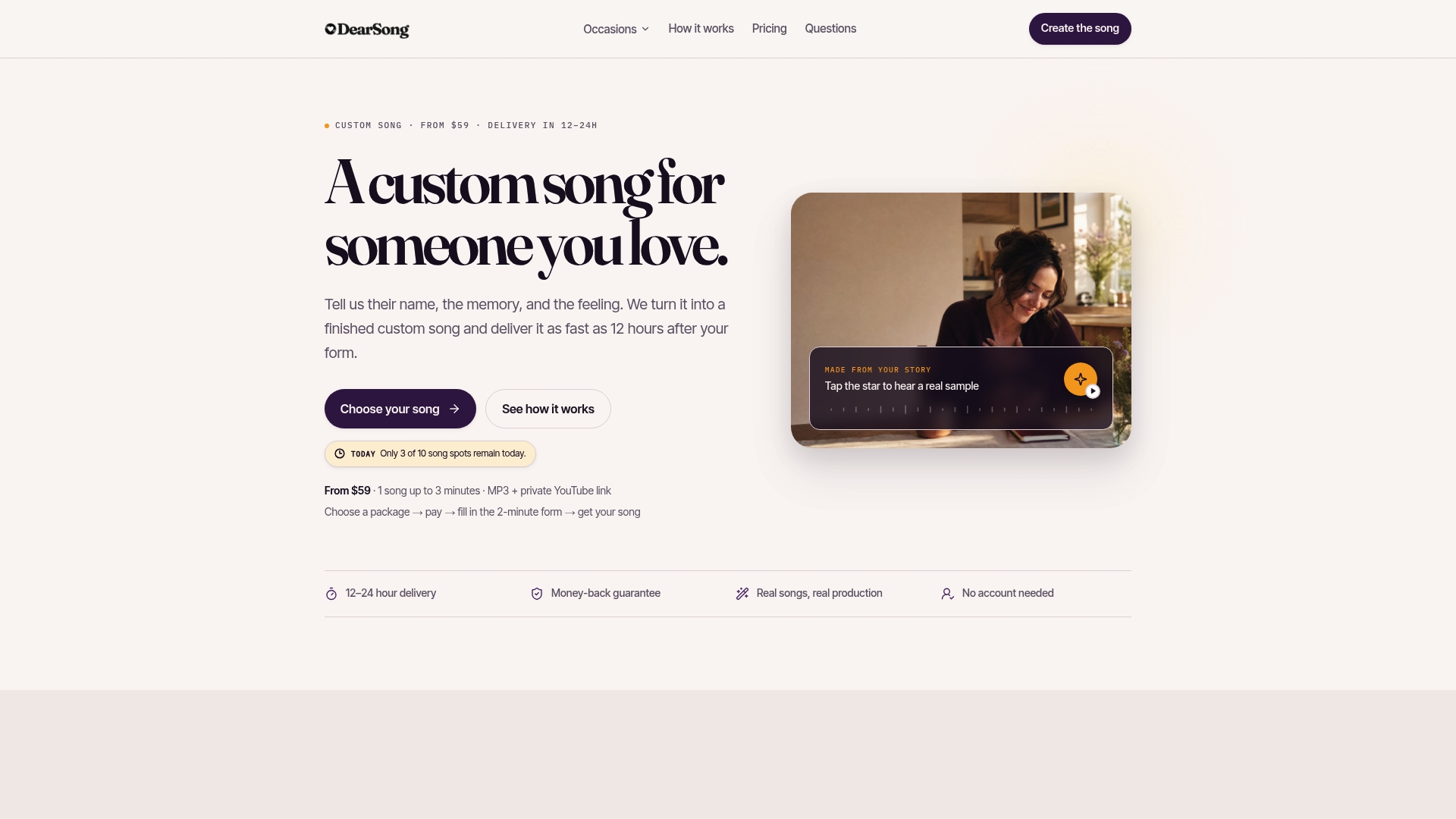
Once your memories are gathered, the order is easy. You choose a package and pay securely, then fill in the short song-details form right away. The delivery clock starts when you submit the completed form. No account is required.
The Essential package is $35 and the Signature package is $89. Signature adds priority delivery, two versions, a lyric rewrite and a printable gift poster, all described on our pricing page. If you already know the occasion, go straight to the matching page: a custom wedding song, love song, birthday song, anniversary song or business jingle. Each starts from $35.
If the date is close, our turnaround guide explains how delivery timing works so you can plan around it.
FAQ
How many memories should I include in a custom song brief?
Two or three specific ones is a good target. A song of up to three minutes has room for a few vivid images, not a life story. Add a short list of names, places and phrases as extras, and let the stronger memories carry the lyric.
What if I do not remember much about the person or event?
Start with what you know, then ask someone who was there. Use open-ended prompts like "tell me about..." and follow up with who, what, when and where. Photos help too. Even small fragments, like a smell or a phrase, are enough to write from.
Can I keep certain details out of the song?
Yes. Add a "please avoid" line to your brief listing any people, events or topics you do not want mentioned. It is most useful for family tensions, health details and past relationships. Being clear up front saves a revision later.
How much does a custom song cost?
Prices vary by provider, so compare what each includes before you order. At Dearsong, Essential is $35 and Signature is $89, as listed on our pricing page. Essential includes one original song, and Signature adds priority delivery, two versions, a lyric rewrite and a printable poster.
Sources
- Smithsonian Institution Archives: How to Do Oral History (2020)
- Smithsonian NMAAHC: Family Oral History Guidelines (2021)
- Smithsonian Center for Folklife: Some Possible Questions
- UNC Southern Oral History Program: Life History Questions
- Greater Good: How to Say Thank You to Your Partner
- Greater Good: Tips for Keeping a Gratitude Journal
- The effects of song familiarity and age on phenomenological characteristics of music-evoked autobiographical memories
- Popular music and movies as autobiographical memory cues
- Memorial Slideshow Songs: Ready to Use Picks by Mood and Relationship
- Custom Gift Surprise Planning: Your 2026 Guide
- Custom song intake form template